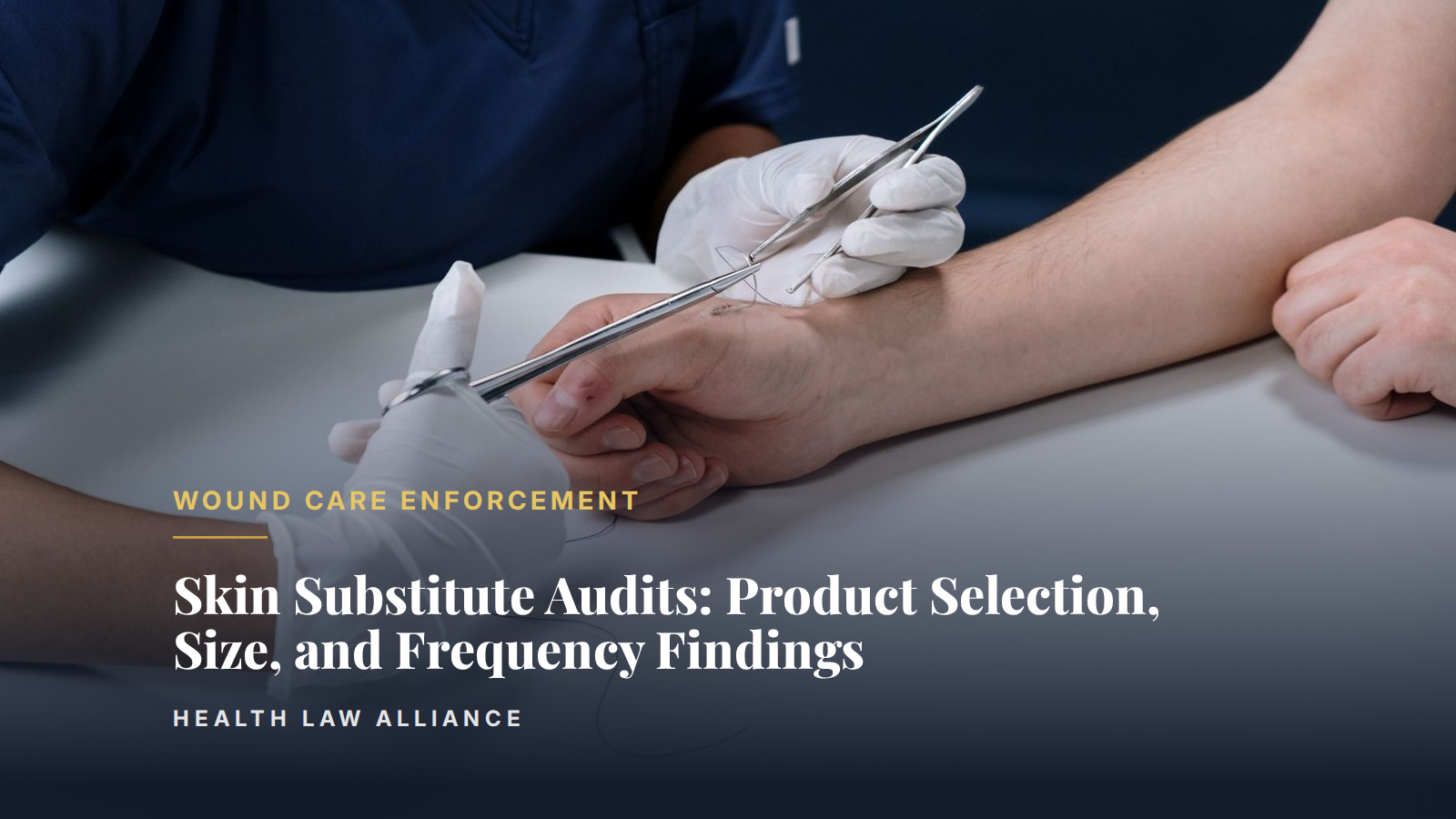
Skin substitute audits are now the sharpest edge of wound care enforcement. Medicare Part B spending on cellular and/or tissue-based products (CTPs), commonly called skin substitutes, exceeded $10 billion in 2024 in non-institutional settings alone, per the HHS Office of Inspector General's September 2025 data snapshot. Effective January 1, 2026, CMS cut skin substitute payment to a flat $127 per square centimeter across a list of only 18 covered products. For providers still billing on legacy habits, the audits landing now test product selection, wound-size documentation, wastage entries, and application counts, the findings behind most skin substitute recoupment demands and False Claims Act referrals opened this year.
The LCD Framework Governing Skin Substitute Claims
Coverage for a skin substitute application runs through the local coverage determination (LCD) in force in the treating provider's Medicare Administrative Contractor (MAC) jurisdiction, not through the CMS payment rule alone. Most LCDs require the wound to have failed at least four weeks of standard conservative care before a graft is medically necessary, and they require baseline wound measurements, dated photographs, and a documented care plan. On December 24, 2025, CMS directed its MACs to withdraw the updated diabetic foot ulcer and venous leg ulcer LCDs that had been scheduled to take effect January 1, 2026, so the legacy medical-necessity criteria continue to control coverage even as the flat per-square-centimeter payment rate took hold on the same date. An auditor tests the chart against the LCD in force at the time of service, not against that week's payment headline.
Product Selection and Wastage Documentation Findings
The government's clearest illustration of a product-selection finding is the Apex Medical matter: the Department of Justice's $309M False Claims Act settlement, announced in January 2026, described sales representatives directed to order the largest graft size available for every patient regardless of the wound in front of them, multiple grafts billed to a single wound, and grafts billed against wounds that did not exist. Auditors now run the same comparison at a smaller scale in nearly every skin substitute review: billed square centimeters against documented wound dimensions. A provider may only bill for the graft actually applied, sized to minimize waste, and any unused portion must be documented by product name, manufacturer, and lot number, with the reason wastage occurred. A chart showing a large graft applied to a small wound, with no wastage entry explaining the gap, reads to an auditor the way it read in Apex: a size chosen for the invoice, not the wound.
The billed square centimeters have to match the wound in the chart, not the graft that was easiest to order.
Application-Count and Frequency Findings
LCD frequency limits cap covered applications within a defined treatment episode, commonly built around an initial course of four applications, with any application beyond that threshold requiring a KX modifier attesting that the wound still meets medical-necessity criteria. UPICs and MACs routinely find two variations on the same problem: the number of applications billed does not match the number documented in the chart, or the treatment episode runs past the 12-week window the LCD contemplates without a new medical-necessity determination. Both extrapolate badly for the provider, because a frequency mismatch on one sampled claim becomes a projected error rate across the full lookback period. The debridement work that often accompanies grafting draws its own scrutiny in the same audit, a pattern covered in Debridement Coding Audits: Depth, Documentation, and CPT 11042-11047.
Why Early Legal Counsel Is Critical
It is critical that wound care providers promptly retain experienced healthcare defense counsel upon receiving a skin substitute audit notice, a UPIC document request, or any other government inquiry. Early legal intervention can protect the provider's rights, ensure appropriate responses to the contractor's requests, avoid inadvertent admissions, preserve every available defense, and let counsel communicate with the auditor on the provider's behalf. Delaying representation can significantly affect the outcome of the matter and expose the provider to False Claims Act risk beyond the underlying recoupment.
How Health Law Alliance Can Help
Health Law Alliance defends wound care providers against skin substitute audits, UPIC and MAC document requests, and the False Claims Act exposure that can follow a product-selection or frequency finding, as part of the firm's broader wound care audit defense practice. Our team includes attorneys who built compliance programs inside major healthcare companies, a background that shapes how we test an auditor's sampling, wastage, and extrapolation methodology before it hardens into a recoupment demand. If your practice has received a skin substitute audit notice, contact us for a free, confidential consultation.