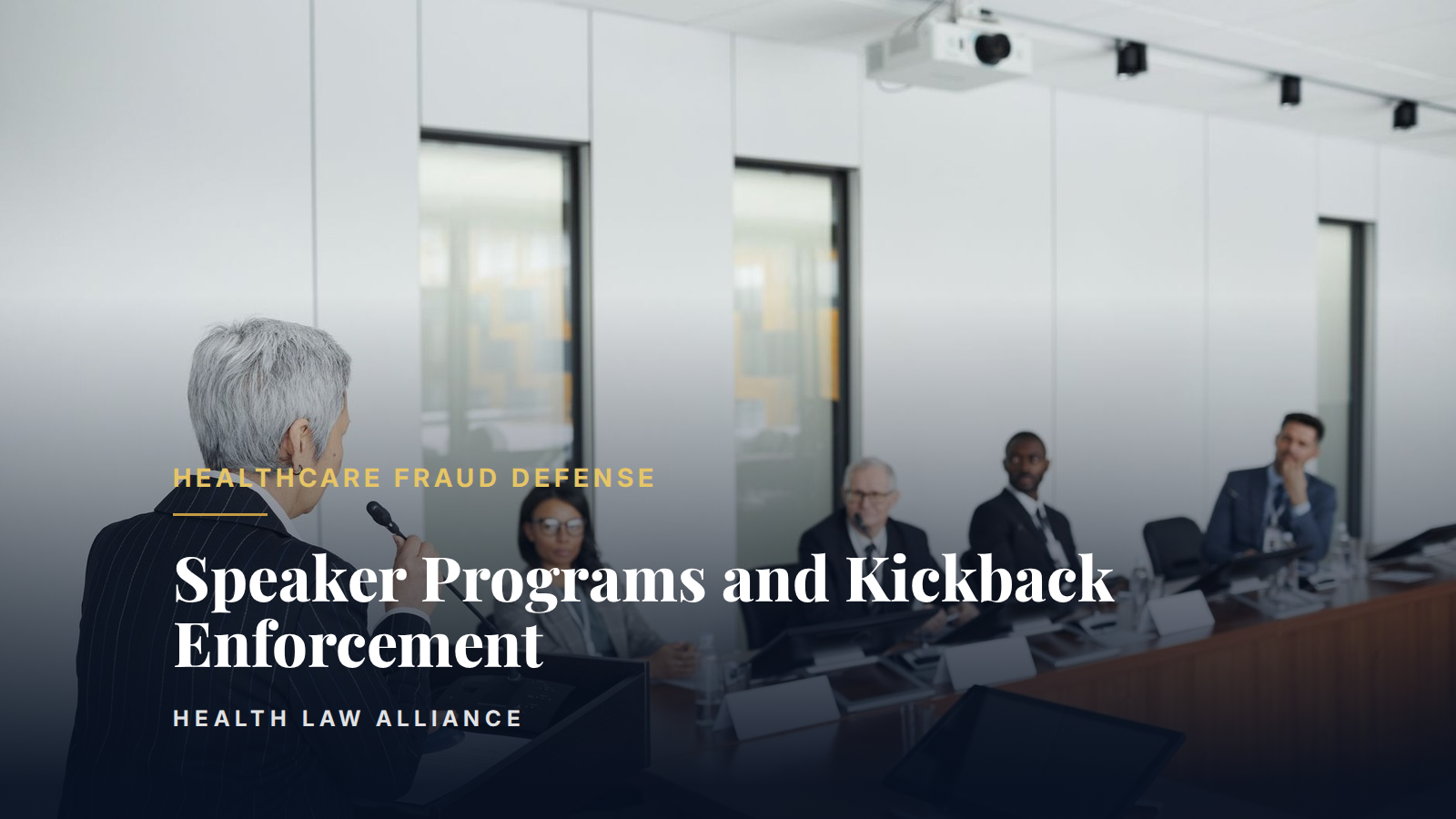
Physician speaker programs, where drug and device companies pay doctors to present to other physicians, remain one of the highest-risk arrangements under the Anti-Kickback Statute. On November 16, 2020, the HHS Office of Inspector General issued a Special Fraud Alert warning that many of these programs function as a vehicle for remuneration rather than education. Two recent False Claims Act settlements, Gilead Sciences' $202 million resolution and Pfizer's $59.7 million settlement over its Biohaven subsidiary, confirm the alert remains the government's active enforcement blueprint five years later. Physicians who speak at or attend these programs face exposure alongside the companies that sponsor them.
What the OIG's Special Fraud Alert Targets
The Special Fraud Alert lists specific suspect characteristics of speaker programs under the anti-kickback statute (42 U.S.C. Section 1320a-7b(b)): little or no substantive content actually presented, alcohol or meals exceeding modest value, venues unsuited to education such as restaurants or entertainment venues, repeated programs covering the same topic without new clinical information, attendees with no legitimate business reason to be present, and speaker selection or compensation tied to the volume or value of a physician's prescriptions. Each characteristic functions as evidence that an educational event has shifted into remuneration for referrals, and a program exhibiting several of them draws the closest scrutiny.
Recent Settlements Confirm the Alert Is Active Policy
In April 2025, the U.S. Attorney's Office for the Southern District of New York announced a $202 million False Claims Act settlement with Gilead Sciences, resolving allegations that from 2011 to 2017 the company paid physicians to attend and speak at events with little or no educational content, often at high-end restaurants, to reward high-prescribing doctors. In January 2025, Pfizer agreed to pay $59.7 million on behalf of its Biohaven subsidiary to resolve claims that the company paid kickbacks, including speaker honoraria and meals at high-end restaurants, to induce prescriptions of the migraine drug Nurtec ODT between March 2020 and September 2022. Both matters trace directly to the characteristics OIG flagged five years earlier.
How Physician Liability Attaches Alongside the Company
The anti-kickback statute reaches both sides of the exchange. A physician who accepts a speaking fee, or attends a program, knowing it exists to reward or induce prescriptions faces the same statute the sponsoring company does, and a pattern of speaker fees paid to a physician who also refers patients within the same practice can separately implicate the stark law compensation rules. These matters rarely start with a target letter. A physician's first notice is often a civil investigative demand or a grand jury subpoena seeking speaker program records, honoraria logs, and attendance sheets.
Speaker Program Investigations Rarely Stay Contained
A civil investigative demand that starts with speaker program records rarely stays limited to those records. Investigators who find gaps in the honoraria log frequently expand the request to prescribing and billing data for the physicians involved, and at that point, Billing Error or Fraud: Where Enforcement Draws the Line becomes directly relevant, since the same investigation can now weigh whether a documentation gap is an honest error or evidence of intent. Responding to a Civil Investigative Demand (CID) and Grand Jury Subpoenas in Healthcare Investigations cover the procedural mechanics of the underlying document requests in more depth.
Elements of a Defensible Speaker Program
A speaker program holds up under scrutiny when it can show genuine educational content tied to a real clinical need, a venue and meal appropriate to that purpose, attendees with a documented business reason to be present, speaker compensation set at fair market value without regard to referral volume, and a program schedule that stops repeating once the clinical content stops changing. Documenting each element as the program is built, not after a subpoena arrives, is what separates a defensible program from the fact patterns OIG and DOJ have already pursued.
A speaker program that cannot show new clinical content, an appropriate venue, and a documented reason for every attendee looks, to a federal investigator, like a kickback with a registration table.
Why Early Legal Counsel Is Critical
It is critical that physicians and practices promptly retain experienced healthcare defense counsel upon receiving a civil investigative demand, grand jury subpoena, or other government inquiry tied to a speaker program. Early legal intervention can protect the physician's rights, shape the response to document requests, avoid inadvertent admissions during interviews, and allow counsel to communicate with investigators directly. Delaying representation can turn a routine document request into an admission that shapes the rest of the matter.
How Health Law Alliance Can Help
Health Law Alliance has handled 5,000+ matters across healthcare regulatory and fraud defense over 25+ years, including Anti-Kickback Statute and speaker program investigations. If you or your practice have received a subpoena, civil investigative demand, or audit request tied to a speaker program or referral arrangement, contact Health Law Alliance's healthcare fraud defense attorneys for a free, confidential consultation.