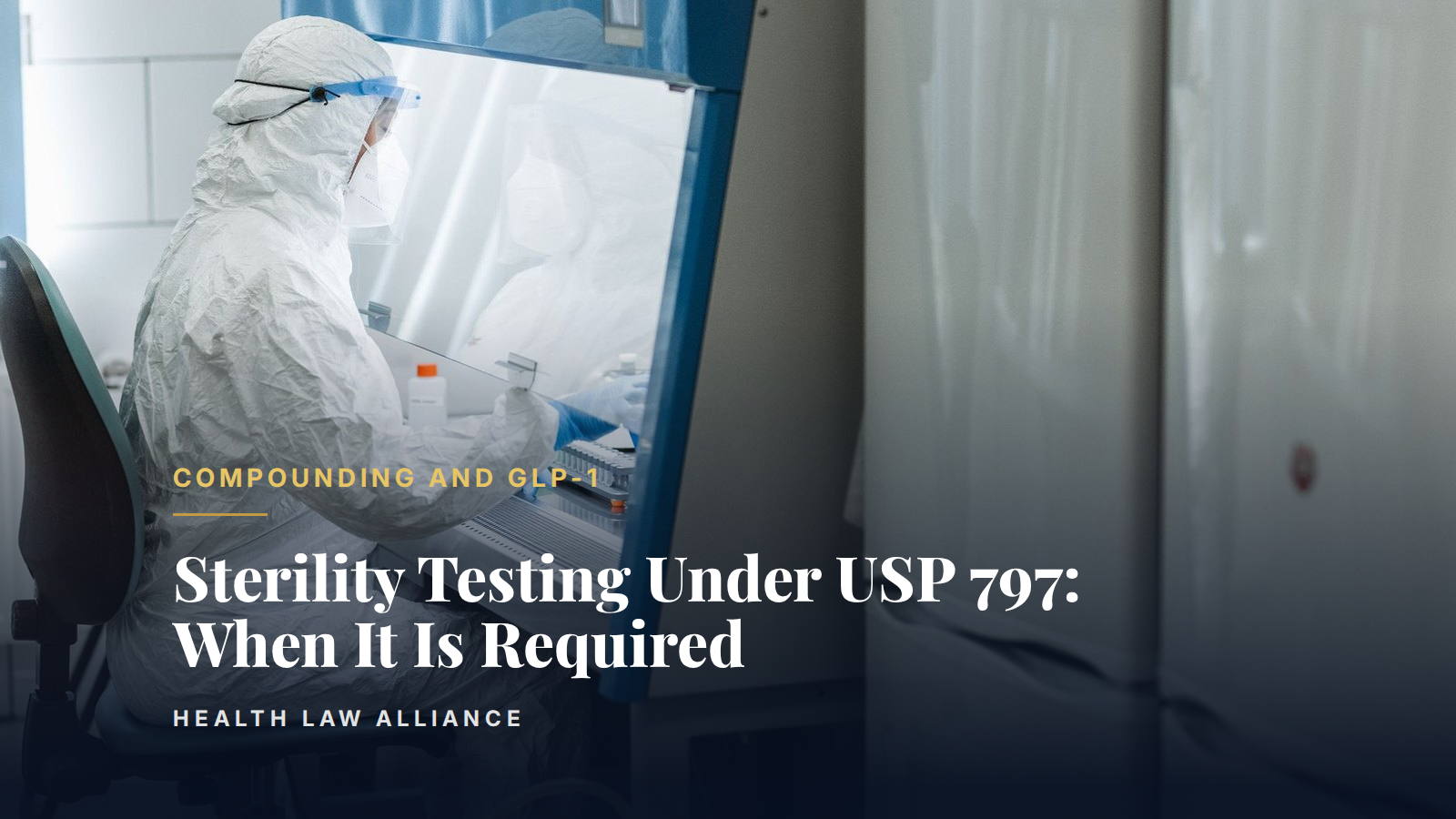
A failed sterility test on a compounded sterile preparation (CSP) can trigger a recall, a board referral, and, in a serious case, an FDA inspection finding. USP General Chapter <797> does not require every CSP to pass a sterility test before it reaches a patient, but the testing trigger is not optional once a pharmacy crosses it. Whether testing is required turns on the preparation's risk category, the beyond-use date assigned to it, the size of the batch, and whether the starting components were sterile to begin with. Health Law Alliance represents compounding pharmacies in the audits and board inquiries that follow a USP <797> finding.
Which Categories Trigger Sterility Testing
USP <797> sorts every CSP into Category 1, Category 2, or Category 3. Category 1 preparations carry the shortest beyond-use dates and are never sterility tested. A Category 2 preparation only picks up the requirement once the pharmacy assigns it a beyond-use date beyond the chapter's no-testing ceiling; held to the shorter window, it never has to pass a sterility test. Category 3 preparations are sterility tested without exception. A separate chapter exemption removes true immediate-use preparations from the framework altogether. How far a passing test can extend a beyond-use date is covered in Extending Beyond-Use Dates: What Justifies It.
The Test Method and the Batch-Size Limit
Where testing is required, USP <797> points to USP Chapter <71> or a validated alternative method noninferior to <71> testing. The chapter caps the batch size for any CSP subject to sterility testing at 250 final yield units, and sets the sample size from that batch: below the size <71> uses for its own sample tables, the pharmacy compounds extra units and tests 10% of the batch, rounded up; at or above that size, <71>'s own sample-size table applies instead. A laboratory testing under <71> must also run its method suitability test, confirming the test can recover contamination from the preparation, before relying on a passing result. Preparations compounded from nonsterile starting components carry a separate bacterial endotoxin testing obligation, covered in Endotoxin Testing Requirements for Sterile Compounds.
Dispensing Before the Results Are Back
USP <797> does not bar dispensing a CSP before its sterility test results are back, but it conditions that choice on having a recall procedure ready if the result comes back positive. A pharmacy that releases a CSP before testing is complete must be able to notify the prescriber immediately of a failed result with the potential to cause patient harm, recall unused dispensed units, quarantine remaining stock, and determine whether other lots are affected. A pharmacy that cannot trace which patients received which lot has already failed this requirement before a test comes back. What follows a failed test is covered in Sterility Testing Failures and Your Response.
The Records an Inspector Will Ask For
An inspector reviewing sterility testing starts with whether the pharmacy can connect the lab report to the units it covers. USP <797> requires the compounding record for each batch to carry an assigned lot, prescription, or order number, the component lot numbers, and the results of the pharmacy's quality-control procedures, and separately requires the facility to retain its release inspection and testing records. A result that cannot be matched to the record for its lot does not establish that the dispensed units were tested. Outsourcing facilities registered under 503B follow the FDA's current good manufacturing practice (cGMP) standards for release testing instead of this chapter, covered in cGMP Expectations for Outsourcing Facilities.
A sterility result an inspector cannot match to a lot number is, for audit purposes, no result at all.
Each of these gaps is its own basis for a citation: a beyond-use date extended as though a sterility test had passed with no passing result in the record, a batch released without the testing its own size triggered, and a sterility result that cannot be tied back to the lot it was supposed to clear.
Why Early Legal Counsel Is Critical
It is critical that compounding pharmacies promptly retain experienced healthcare defense counsel upon receiving a sterility-testing citation, a state board inquiry, or an FDA Form 483 observation. Early legal intervention can protect the pharmacy's rights, ensure appropriate responses to government requests, avoid inadvertent admissions, preserve relevant defenses, and allow counsel to communicate with investigators on the pharmacy's behalf. Delaying legal representation can significantly affect the outcome of a matter and expose the pharmacy to unnecessary risk.
How Health Law Alliance Can Help
Health Law Alliance's attorneys have overseen 2,000+ audits and handled 5,000+ matters, with 25+ years of experience. If your pharmacy is facing a sterility-testing citation or a broader USP <797> inspection finding, contact Health Law Alliance's compounding pharmacy attorneys for a free, confidential consultation.