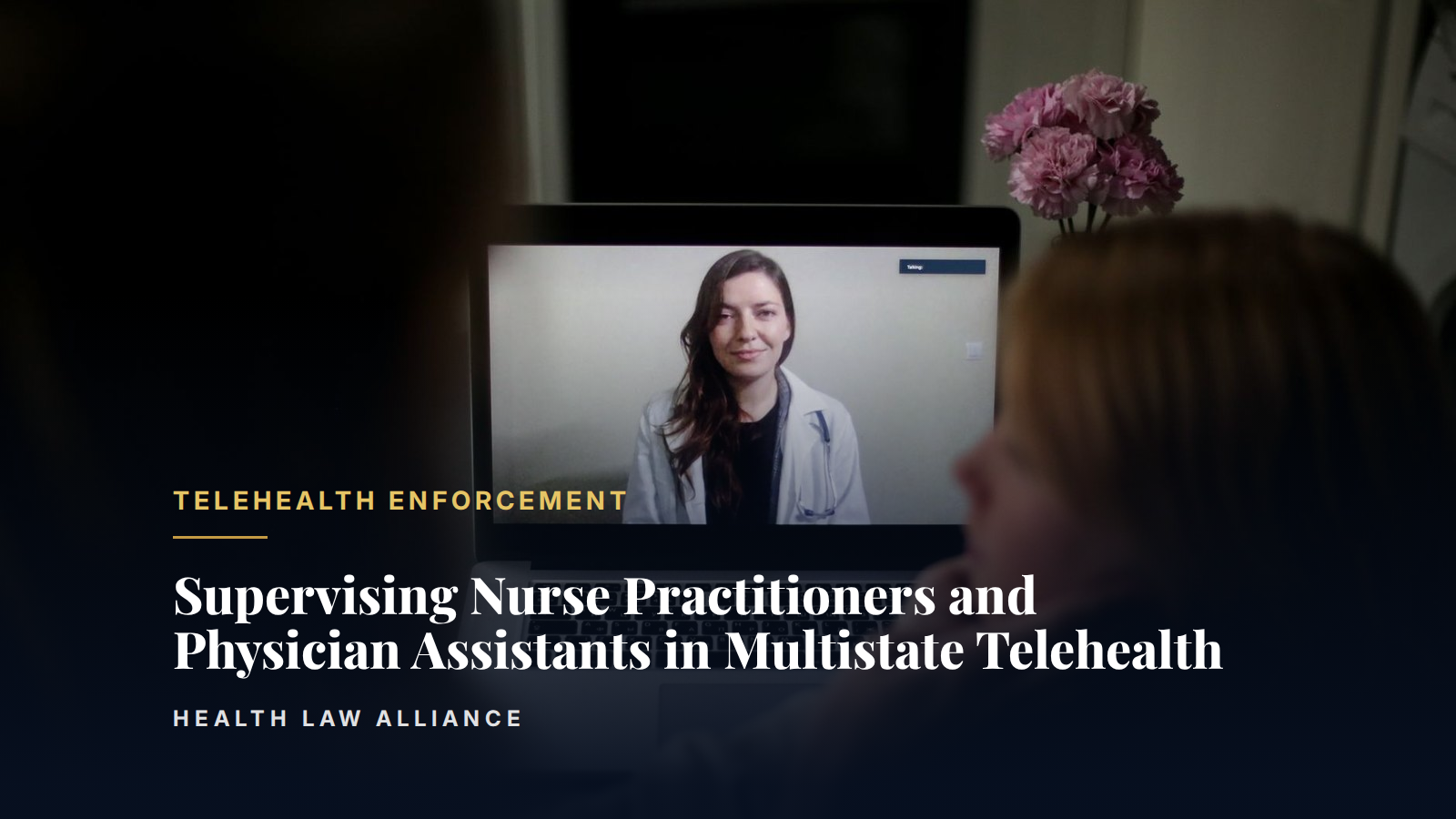
A nurse practitioner or physician assistant sitting in one state and treating a patient who logs on from another is practicing under two separate legal frameworks at once, and payers and licensing boards are now testing both after the fact. The clinician generally needs a license or telehealth registration in the state where the patient is physically located, and that same state's scope-of-practice and physician-collaboration rules govern the visit, not the clinician's home-state rules. A collaborative practice or supervision agreement written for an in-person clinic does not automatically cover a visit that moves to video or phone.
Two States, One Governing Framework
State medical and nursing boards treat a telehealth encounter as occurring where the patient is located, not where the clinician is sitting. That rule does two things at once: it requires the advanced practice clinician to hold a license, or a recognized telehealth registration or interstate compact privilege, in the patient's state, and it makes that state's scope-of-practice and collaboration law the one governing the visit. A nurse practitioner licensed under a full-authority state's rules does not carry that authority into a visit with a patient sitting in a state that requires physician collaboration. The APRN Compact, administered by the National Council of State Boards of Nursing, would eventually let a covered nurse practitioner hold one multistate privilege among member states, but as of 2026 only five states have enacted it against the seven needed for it to take effect, so it is not yet operational anywhere.
What the Agreement Has to Say About Telehealth
The American Association of Nurse Practitioners groups state law into three categories: full practice states, where board of nursing licensure alone is sufficient; reduced practice states, which condition at least one element of practice, often prescribing, on a career-long collaborative agreement; and restricted practice states, which require ongoing supervision, delegation, or team management by a physician. Physician assistants sit under a parallel range of state supervision statutes. A written agreement built for an in-person clinic rarely addresses how the collaborating or supervising physician stays reachable during a telehealth visit, or whether its chart-review and countersignature terms apply per encounter regardless of modality. Compensation structures tied to the arrangement also have to be checked against the anti-kickback statute, a question multistate telehealth staffing models raise often enough to warrant its own dedicated analysis.
What the Chart Has to Show
Whatever the agreement requires, the chart is where a reviewer looks for proof it happened: the identity of the collaborating or supervising physician for that date of service, documentation of any consultation the case required, and, where the agreement calls for it, a periodic or per-encounter chart review and countersignature from the physician. Some agreements set a numeric review quota, others require sign-off within a fixed number of days, and others drop the countersignature requirement once the clinician clears an initial period. None of these approaches is universal, and a chart built to satisfy one state's requirement can fall short of another state's requirement for the same visit type.
How Payers and Boards Test the Arrangement Later
The test almost never happens in real time. A Unified Program Integrity Contractor or a state board investigator reconstructs the arrangement months later, pulling the agreement alongside the chart and checking whether the review and countersignature pattern it promised is actually documented. A gap between what the agreement requires and what the record shows reads as a compliance failure whether or not the underlying care was appropriate, and it can trigger a recoupment demand, a licensure inquiry, or both. Billing under a mismatched supervision arrangement at volume can escalate a payer audit into False Claims Act territory, particularly where the pattern suggests the practice knew its telehealth documentation did not match its own agreement.
An agreement drafted for a clinic visit does not answer for a telehealth visit unless someone rewrote it to, and the chart is where that gap gets found.
Why Early Legal Counsel Is Critical
It is critical that practices deploying nurse practitioners and physician assistants across state lines by telehealth promptly retain experienced healthcare defense counsel to review licensure coverage, collaboration agreements, and chart documentation before a payer audit or board inquiry arrives, not after. Early legal intervention can identify which state's scope-of-practice rules actually govern a given patient population, confirm the agreement addresses telehealth specifically, and correct a countersignature or chart-review gap before it hardens into a recoupment demand or a licensure referral. Delaying can let an outdated, clinic-only agreement stay in place across an entire multistate program.
How Health Law Alliance Can Help
Health Law Alliance has handled 5,000+ matters across healthcare regulatory and audit defense over 25+ years, including multistate telehealth supervision and collaborative practice arrangements for nurse practitioners and physician assistants. If your practice is expanding advanced practice clinicians across state lines by telehealth, or a payer or board has already questioned how a telehealth visit was supervised, contact Health Law Alliance's telehealth defense attorneys for a free, confidential consultation before the response window runs.