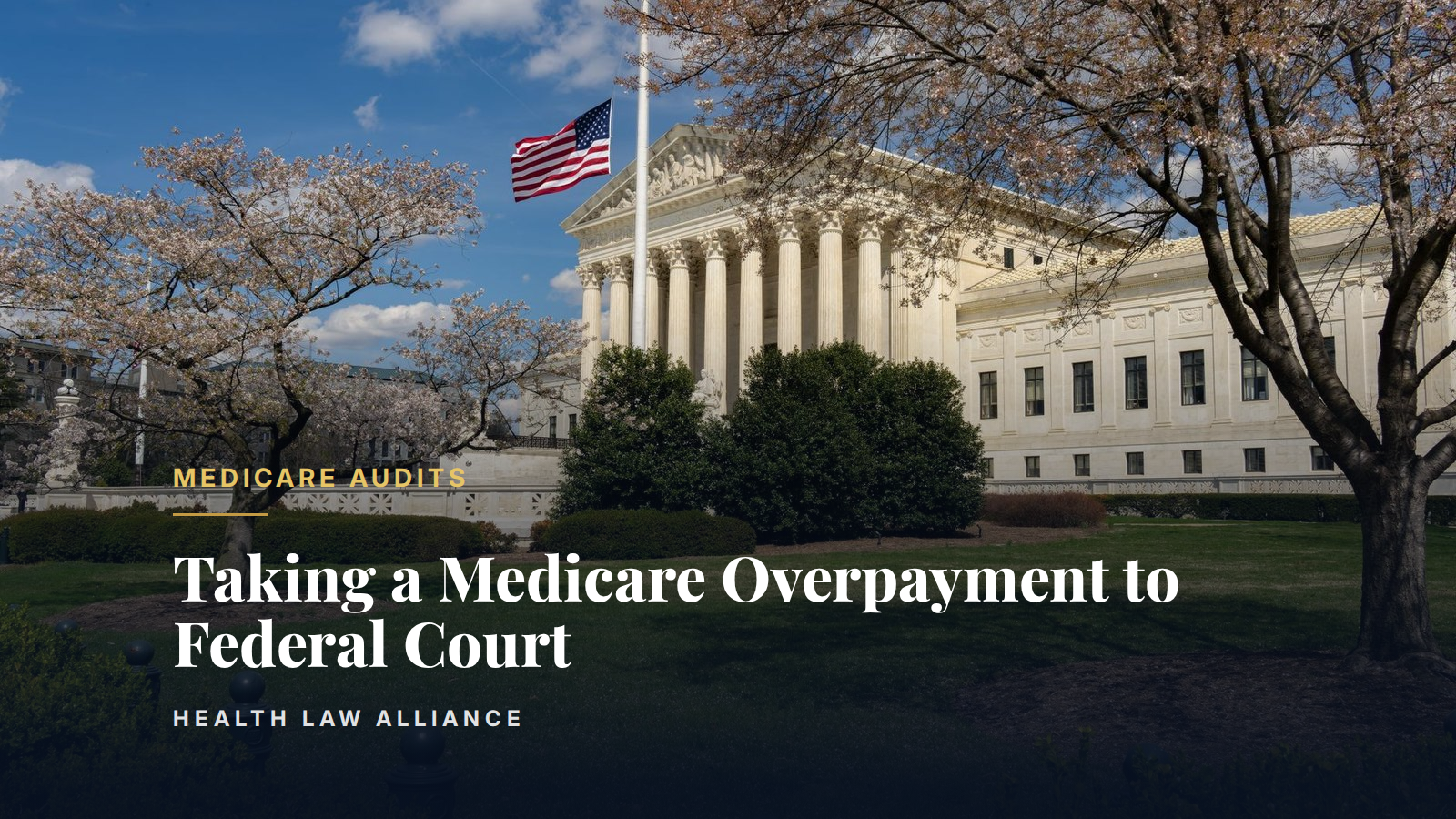
A Medicare overpayment demand does not end when a contractor issues its findings. Providers who exhaust redetermination, reconsideration, an Administrative Law Judge (ALJ) hearing, and review by the Medicare Appeals Council may carry the dispute into federal district court under 42 U.S.C. § 405(g), as incorporated into the Medicare statute by 42 U.S.C. § 1395ff(b)(1)(A). For a physician or pharmacy facing a large recoupment, the exhaustion requirement, the dollar threshold to reach the courthouse, and the standard of review a judge will apply all shape whether this stage of the fight is worth pursuing.
Exhausting the Five Levels of Administrative Appeal
Federal court review is not available on request. In Heckler v. Ringer, the Supreme Court confirmed that Medicare claimants generally must complete the administrative process before a district court has jurisdiction to hear the case. The path runs through five levels: redetermination by the Medicare Administrative Contractor (MAC), filed within 120 days; reconsideration by a Qualified Independent Contractor (QIC), filed within 180 days; a hearing before an Administrative Law Judge (ALJ) at the Office of Medicare Hearings and Appeals (OMHA); review by the Medicare Appeals Council; and only then judicial review. Overpayment findings often trace back to a contractor audit, covered in our overview of the Medicare Audit Process: Contractors, Stages, and Deadlines, so the appeal clock is already running by the time the demand letter arrives.
Amount in Controversy and the 60-Day Filing Deadline
Two dollar thresholds control access to review beyond the QIC level. CMS adjusts both figures annually for inflation. For calendar year 2026, the amount in controversy is $200 to reach an ALJ hearing and $1,960 to reach federal court. Once the Medicare Appeals Council issues its decision, or fails to act within its 90-day adjudication period under 42 C.F.R. § 405.1132, the provider may request escalation and then file a civil action in federal district court within 60 calendar days, as set out in 42 C.F.R. § 405.1136.
The Substantial Evidence Standard of Review
Federal court review of a Medicare overpayment decision is narrow. Under 42 U.S.C. § 405(g), the Secretary's findings of fact are conclusive if supported by substantial evidence, meaning the relevant evidence a reasonable mind would accept as adequate to support the conclusion. The court confirms whether the agency applied the correct legal standard and whether the record, including any extrapolation methodology used to calculate the demand, supports the result.
Federal court review of a Medicare overpayment is a narrow check on whether the agency followed the law, not a second chance to argue the facts.
Realistic Timelines and Prospects
OMHA's processing times have improved after years of a severe backlog that once stretched past a thousand days per case; recent average decision times run closer to the 90-day regulatory target, though results vary by docket and region. A provider who reaches federal court is litigating on a paper record built over several years, and reversal requires showing the agency's decision lacked substantial evidence or rested on a legal error, a difficult standard to meet when the dispute centers on a statistical extrapolation. Our discussion of Challenging Extrapolation in Medicare Overpayment Demands covers how that issue is best raised earlier, while the ALJ record is still being built.
Why Early Legal Counsel Is Critical
It is critical that providers promptly retain experienced healthcare defense counsel upon receiving a Medicare overpayment demand or an unfavorable redetermination. Early legal intervention can protect a provider's appeal rights, ensure appropriate responses to contractor and CMS requests, avoid inadvertent admissions, preserve relevant defenses including extrapolation challenges, and allow counsel to communicate with auditors and adjudicators on the provider's behalf. Delaying legal representation can significantly affect the outcome of a matter and expose a practice to unnecessary risk.
How Health Law Alliance Can Help
Health Law Alliance guides providers through the full Medicare appeal record, from the first redetermination request through a request for judicial review, and has overseen 2,000+ audits for pharmacies and providers nationwide. Providers who have received an unfavorable Medicare Appeals Council decision, or who are earlier in the process and want the record built correctly from the start, can contact us for a free, confidential consultation about Medicare Audit Defense.