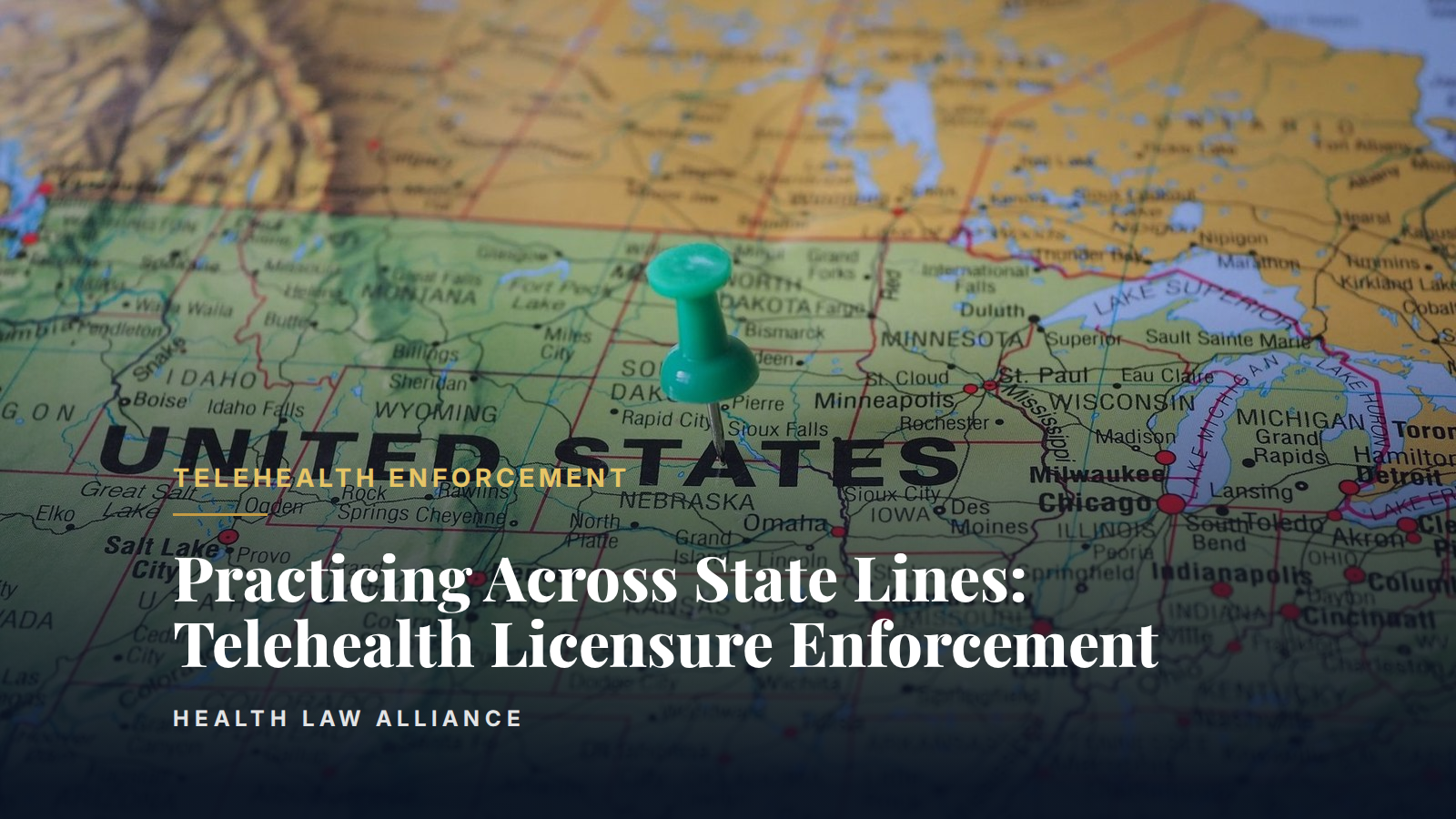
A federal court in the District of New Jersey dismissed a constitutional challenge to the state's telehealth licensing law on May 12, 2025, brought by a Massachusetts radiation oncologist and a Pennsylvania neurosurgeon who wanted to keep treating patients after they relocated to New Jersey. Neither physician held a New Jersey license. The ruling confirms what many telehealth providers underestimate: a license in the provider's home state does not authorize treatment of a patient physically located in a state where the provider is not licensed. For telehealth providers who prescribe or consult across state lines, unlicensed-practice exposure is an active enforcement risk, not a hypothetical one.
The Licensure Rule Behind Every Telehealth Visit
State medical boards apply the same baseline rule: the practice of medicine is deemed to occur where the patient is physically located during the encounter. A physician licensed in New York who treats a patient logged in from Florida is practicing medicine in Florida for licensure purposes, and needs a Florida license or a recognized exemption before that visit occurs. Exceptions are narrow. Some states allow a single consultation with a local, in-state physician, or a limited continuity-of-care window for a patient the out-of-state provider already treated in person. Wyoming's Board of Medicine adopted an emergency rule in 2026 confirming that a physician-patient relationship formed by telemedicine counts as practicing medicine in Wyoming unless a specific exemption applies, including consultation with a Wyoming-licensed attending physician or up to six months of continuity-of-care service to an established patient. Prescribing controlled substances by telehealth adds a separate federal layer on top of that state requirement.
What Licensure Compacts Actually Cover
The Interstate Medical Licensure Compact now counts 44 member states as of mid-2026, with Alaska the most recent addition. The compact speeds up licensing rather than replacing it, creating an expedited process for a qualifying physician to obtain a separate license in each member state faster than applying independently. The physician still holds an individual license in every state where a patient sits. Psychologists have a parallel pathway through PSYPACT, active in 43 states and territories, which issues a telepsychology practice credential rather than a single license. Nurse practitioners and registered nurses have the Nurse Licensure Compact. Each compact cuts paperwork; the underlying licensing requirement and the board's disciplinary authority remain fully intact.
Board Discipline Reaches Out-Of-State Prescribers
A board does not need a provider to live in the state, or ever set foot in it, to discipline that provider. Alaska's medical board can sanction an out-of-state physician for treating an Alaska patient without the required credential, and recover its investigation and hearing costs from that physician. New Jersey treats unlicensed telehealth practice as a criminal matter, not just a licensing one. The May 2025 ruling tested that framework directly, rejecting Dormant Commerce Clause, Privileges and Immunities Clause, and First and Fourteenth Amendment challenges, and upholding the license requirement regardless of how long the physician-patient relationship had existed before the patient moved.
Licensure Exposure Rarely Travels Alone
A licensure gap rarely appears alone. The same intake and scheduling records that show where a patient was physically located when treated are the records federal investigators pull when building a telehealth fraud case, and the records payors pull when auditing modifier and originating-site compliance on the claim. DOJ's telehealth fraud enforcement priorities and Medicare's telehealth billing audits often start with the same location and documentation gaps that create licensure exposure. A provider that has not mapped where its patients are physically located when care is delivered is exposed on more than one front.
A license in the provider's home state does not authorize treatment of a patient physically located in a state where the provider is not licensed. The patient's location controls, not the provider's.
Why Early Legal Counsel Is Critical
It is critical that telehealth providers promptly retain experienced healthcare defense counsel upon receiving a state board inquiry, cease-and-desist letter, subpoena, or other government inquiry tied to cross-state practice. Early legal intervention can protect the provider's license, ensure appropriate responses to board requests, avoid inadvertent admissions about where and how care was delivered, and preserve applicable compact and exemption defenses. Delaying legal representation can significantly affect the outcome of a licensure matter and expose the provider to unnecessary disciplinary or criminal risk.
How Health Law Alliance Can Help
Health Law Alliance defends telehealth providers, medical groups, and healthcare companies against state board licensure inquiries, cease-and-desist letters, and disciplinary actions tied to cross-state telehealth practice. The firm's bench includes attorneys who have sat inside the regulatory system now scrutinizing multistate telehealth models. If your practice has received a licensure inquiry, or you want a cross-state telehealth program reviewed before it draws one, contact us for a free, confidential consultation.