
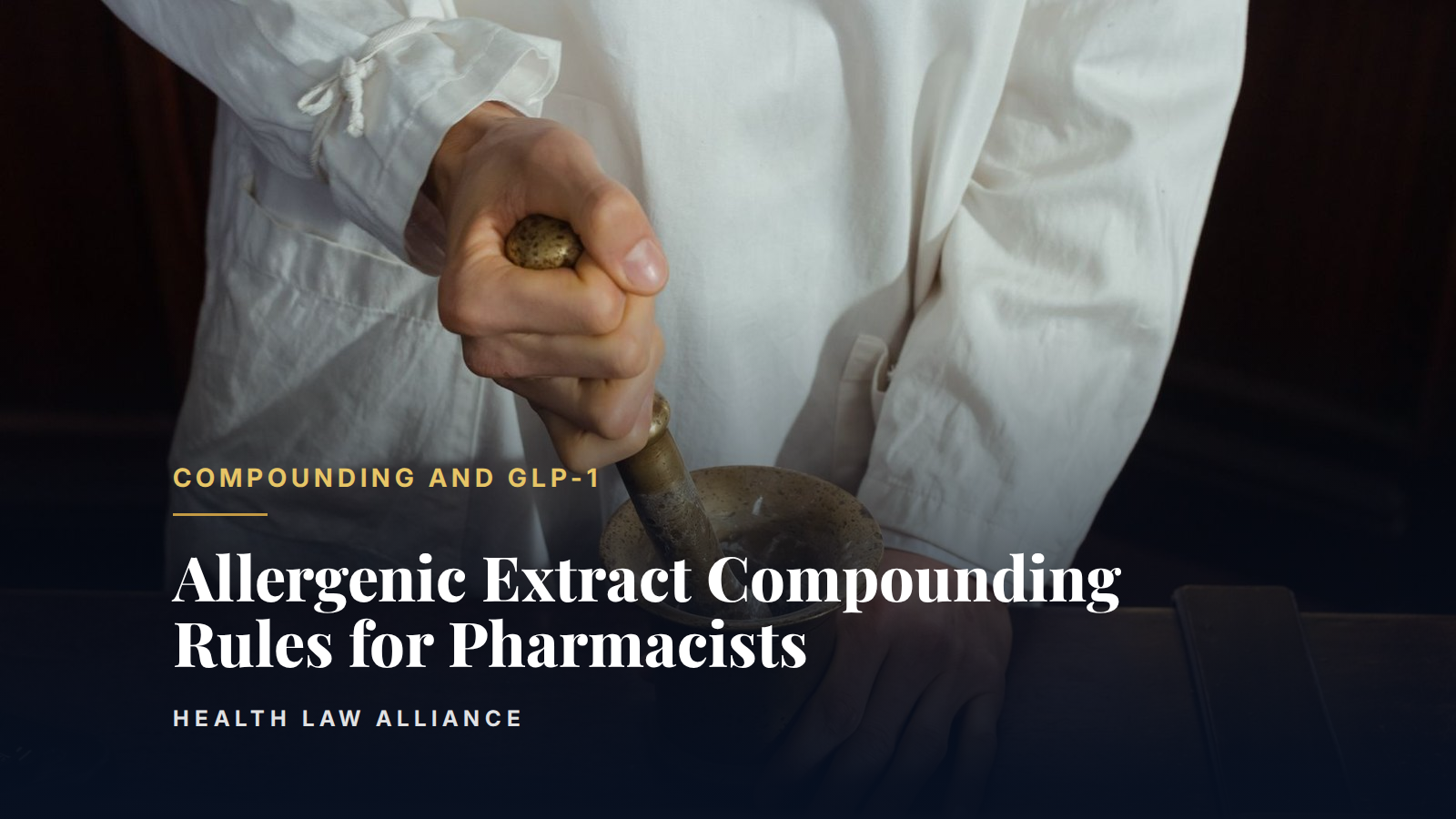
Allergenic extracts are licensed biologics, and mixing or diluting them into a patient-specific prescription set is compounding under two regulatory regimes running at the same time. The Food and Drug Administration treats the mixed vials as a prescription set operating inside a narrow enforcement-discretion carve-out, not a new biologic requiring its own license. The compounding pharmacist's state board of pharmacy separately enforces the USP 797/800 sterile compounding standard that governs how the dilution happens, how it gets documented, and how long the finished vial can sit on the shelf. A gap in either layer, an unlogged dilution ratio, a beyond-use date that outruns a component's own expiration, is what a state board inspection or an FDA Form 483 finds first.
FDA's Prescription Set Framework for Allergenic Extracts
The Food and Drug Administration's January 2018 guidance, Mixing, Diluting, or Repackaging Biological Products Outside the Scope of an Approved Biologics License Application, sets the terms. FDA will not pursue a Public Health Service Act licensing violation against a physician's office, a state-licensed pharmacy, or a 503B outsourcing facility that prepares a prescription set from FDA-licensed allergenic extracts and diluents that are sterile and pharmaceutical grade, fills it only against a valid patient-specific prescription, and keeps the combination consistent with each extract's approved labeling. A closer look at how the two compounding frameworks diverge for allergenic extracts specifically is in 503A vs 503B: Which Framework Governs Your Compounding. An outsourcing facility that prepares prescription sets still owes FDA cGMP recordkeeping on top of the prescription-set conditions.
USP Chapter 797 Preparation and Dilution Documentation Standards
Condition six of FDA's guidance ties the enforcement discretion to USP <797>, the sterile compounding chapter's Section 21 carve-out for allergenic extracts. The 2023 revision lets a compounding pharmacist prepare prescription sets using general aseptic technique, without the ISO Class 5 primary engineering control required for most other compounded sterile preparations, but it does not relax the paperwork. Every prescription set needs a compounding record naming the extract, the dilution ratio, and the vial number in the series; a label carrying the patient's name, the fractional dilution, and the beyond-use date; and a beyond-use date that is no later than the earliest expiration date of any extract or diluent in the set and never more than one year from the day the vials were mixed. A missed dilution entry or a vial-number sequence that does not match the compounding record is the same documentation gap covered in Beyond-Use Dating: Where Compounders Get Cited.
The dilution log is what keeps a prescription set inside FDA's enforcement discretion instead of outside it.
Where State Board of Pharmacy Rules Add a Second Layer
FDA's guidance answers the federal licensing question, not the state licensing question. A compounding pharmacy still needs a valid pharmacy license and a sterile compounding permit from its state board of pharmacy to prepare prescription sets at all. Some states exempt a physician's office that mixes allergenic extracts under the treating physician's own license and route oversight to the state medical board instead; a pharmacy does not get that exemption. State board inspectors apply the same 503A/503B sterile compounding standards to an allergy department's dilution records that they apply to any other compounded sterile preparation, and a citation at the state level can trigger an FDA referral even when the underlying prescription set met every federal condition. The response window that follows is addressed in FDA Form 483 Observations: The 15-Day Response.
Why Early Legal Counsel Is Critical
It is critical that compounding pharmacies promptly retain experienced healthcare defense counsel upon receiving a state board of pharmacy inspection finding, an FDA Form 483, or any other government inquiry into allergenic extract preparation. Early legal intervention can protect the pharmacy's rights, ensure appropriate responses to investigator requests, avoid inadvertent admissions, preserve every available defense, and let counsel communicate with the board or the agency on the pharmacy's behalf. Delaying legal representation can significantly affect the outcome of a matter and expose the pharmacy to unnecessary licensure risk.
How Health Law Alliance Can Help
Health Law Alliance defends compounding pharmacies through state board of pharmacy investigations, FDA warning letters, and Form 483 findings tied to allergenic extract preparation as part of the firm's compounding pharmacy attorneys practice. The team reviews dilution records, prescription-set labeling, and beyond-use dating against both the FDA prescription-set conditions and the applicable state board's sterile compounding rules before a finding becomes a licensure action. If your pharmacy has received an inspection finding or wants its allergenic extract documentation reviewed before one arrives, contact us for a free, confidential consultation.