
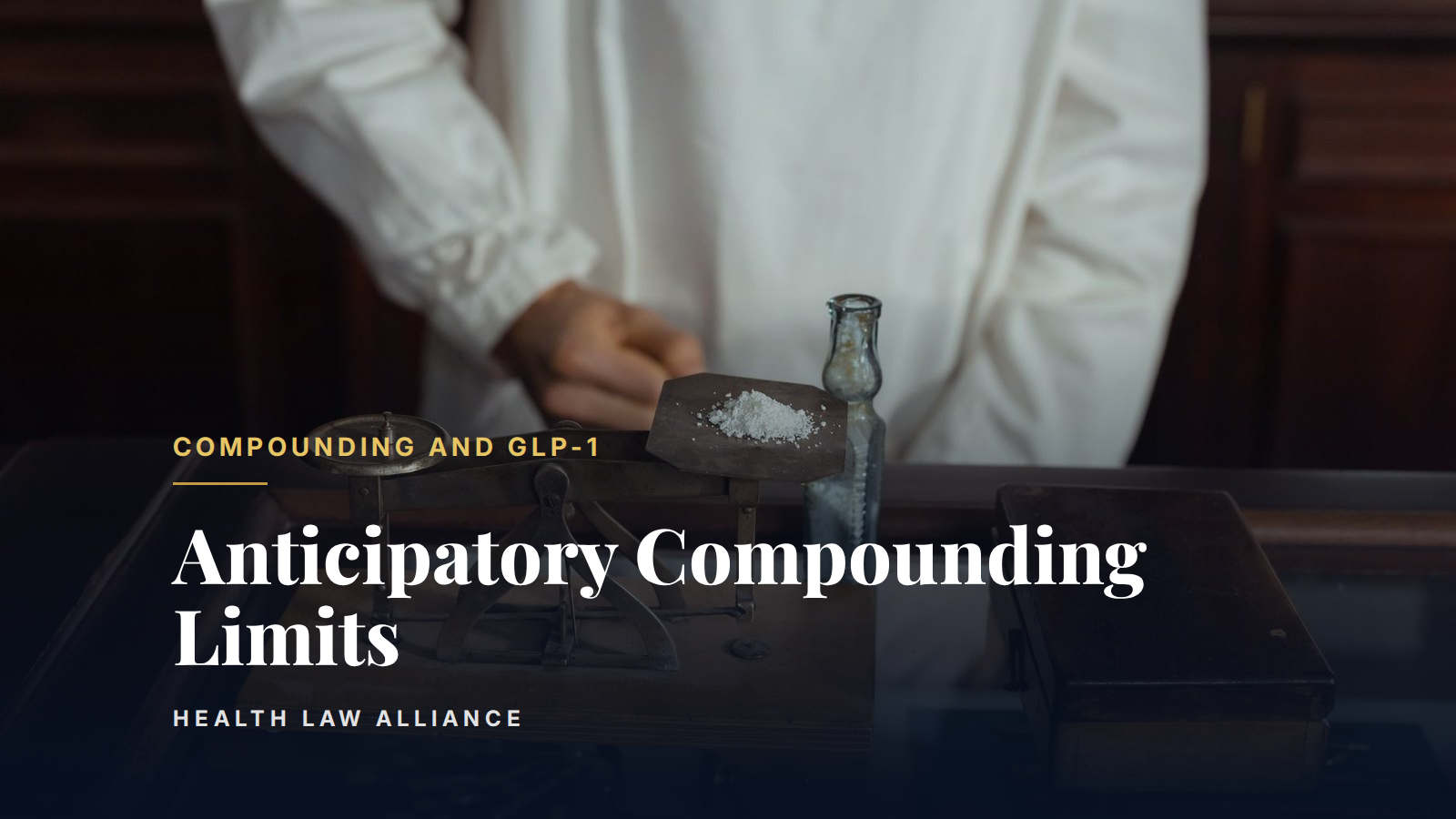
Anticipatory compounding lets a licensed pharmacist prepare a compounded drug product before a patient-specific prescription for it arrives, and federal law puts a hard limit on how much can sit on the shelf waiting for one. Section 503A of the Federal Food, Drug, and Cosmetic Act, 21 U.S.C. § 353a, exempts pharmacy-compounded drugs from FDA premarket approval, labeling, and current good manufacturing practice requirements only when the compounding tracks an identified patient's prescription, whether already received or reasonably anticipated. A compounding pharmacy that builds inventory beyond what its own prescribing history supports steps outside that exemption, and an inspector who finds the gap treats the excess product as an unapproved drug.
The Section 503A Prescription Requirement
Section 503A(a) allows two paths to the exemption. Under section 503A(a)(1), a pharmacist compounds after receiving a valid prescription order, or a physician compounds after entering a notation in a patient's health record. Under section 503A(a)(2), a pharmacist or physician instead compounds in limited quantities before a prescription order arrives, the anticipatory compounding pathway. Either way, FDA's guidance is explicit that a compounded drug can be distributed only pursuant to a valid, patient-specific prescription. The statute does not authorize handing product to a patient or prescriber before that prescription exists. The 503A/503B line separates individualized pharmacy compounding from the manufacturing-grade controls that apply to outsourcing facilities.
The History and Established Relationship Test
Anticipatory compounding under section 503A(a)(2) is not a license to guess at demand. FDA requires two conditions read together: the compounding must be based on a history of the pharmacist or physician receiving valid prescription orders for that specific drug product, and those orders must have been generated solely within an established relationship, either with the patient who will receive the drug or with the prescriber who will write the order. A pharmacy compounding a formulation it has no documented prescribing history for, or building inventory against prescribers it has never filled for, cannot rely on this pathway even if the quantity is small. The test runs on the compounder's own records, not industry averages or projected demand.
FDA's 30-Day Supply Compliance Policy
FDA's December 2016 guidance, Prescription Requirement Under Section 503A, sets out a nonbinding interim compliance policy for measuring limited quantities. Under that policy, FDA does not intend to question a compounder's anticipatory supply of a given product if the compounder holds no more than a 30-day supply for distribution, sized to the highest volume of valid patient-specific prescriptions it received for that product in any 30-day period over the trailing year. The reference period moves: a compounder that filled 500 units in its best 30-day stretch last year, then fills 750 units in a more recent 30-day window, can rebuild its anticipatory supply up to 750 units. The 30-day figure does not override a shorter beyond-use date. A product with a 9-day BUD cannot be compounded in quantities that outlast it, regardless of prescription volume.
Anticipatory Compounding After the GLP-1 Shortage Delisting
The 30-day limit carries new weight for compounders that scaled semaglutide and tirzepatide production during the FDA drug shortage delisting period. Once FDA removed those drugs from the shortage list, compounders lost the separate shortage-based exemption and were pushed back onto the ordinary section 503A framework, including its anticipatory ceiling and its cGMP exemption conditions. State boards of pharmacy that inspect compounding facilities routinely reconcile on-hand inventory against dispensing records to test whether anticipatory production tracks a documented prescription history or was built ahead of it. A compounder whose inventory outpaces its own 30-day prescribing history, and whose sterile or hazardous compounding practices depart from USP 797/800, faces exposure on both fronts at once.
FDA does not treat the 30-day figure as a hard cap. It treats it as the outer edge of a nonbinding compliance policy that tracks the compounder's own prescription history, not a license to build inventory ahead of demand.
Why Early Legal Counsel Is Critical
It is critical that compounding pharmacies and physician compounders promptly retain experienced healthcare defense counsel upon receiving an FDA Form 483 observation, a state board of pharmacy inspection finding, or any other government inquiry touching anticipatory compounding volume. Early legal intervention can protect the compounder's rights, ensure an accurate response to the reviewing agency, avoid inadvertent admissions about inventory practices, preserve self-disclosure options, and let counsel communicate with investigators on the compounder's behalf. Delaying representation can significantly affect the outcome, particularly once inventory and dispensing records are already in an inspector's file.
How Health Law Alliance Can Help
Health Law Alliance defends compounding pharmacies and physician compounders whose anticipatory production is questioned during an FDA inspection, a state board of pharmacy review, or a PBM audit of compounded claims, as part of the firm's compounding pharmacy defense practice. The firm reviews a pharmacy's prescription history, established-relationship documentation, and beyond-use dating against the section 503A framework to build a defensible record before an inspection finding hardens into a warning letter or a board complaint. If your pharmacy's anticipatory compounding practices are under review, contact us for a free, confidential consultation.