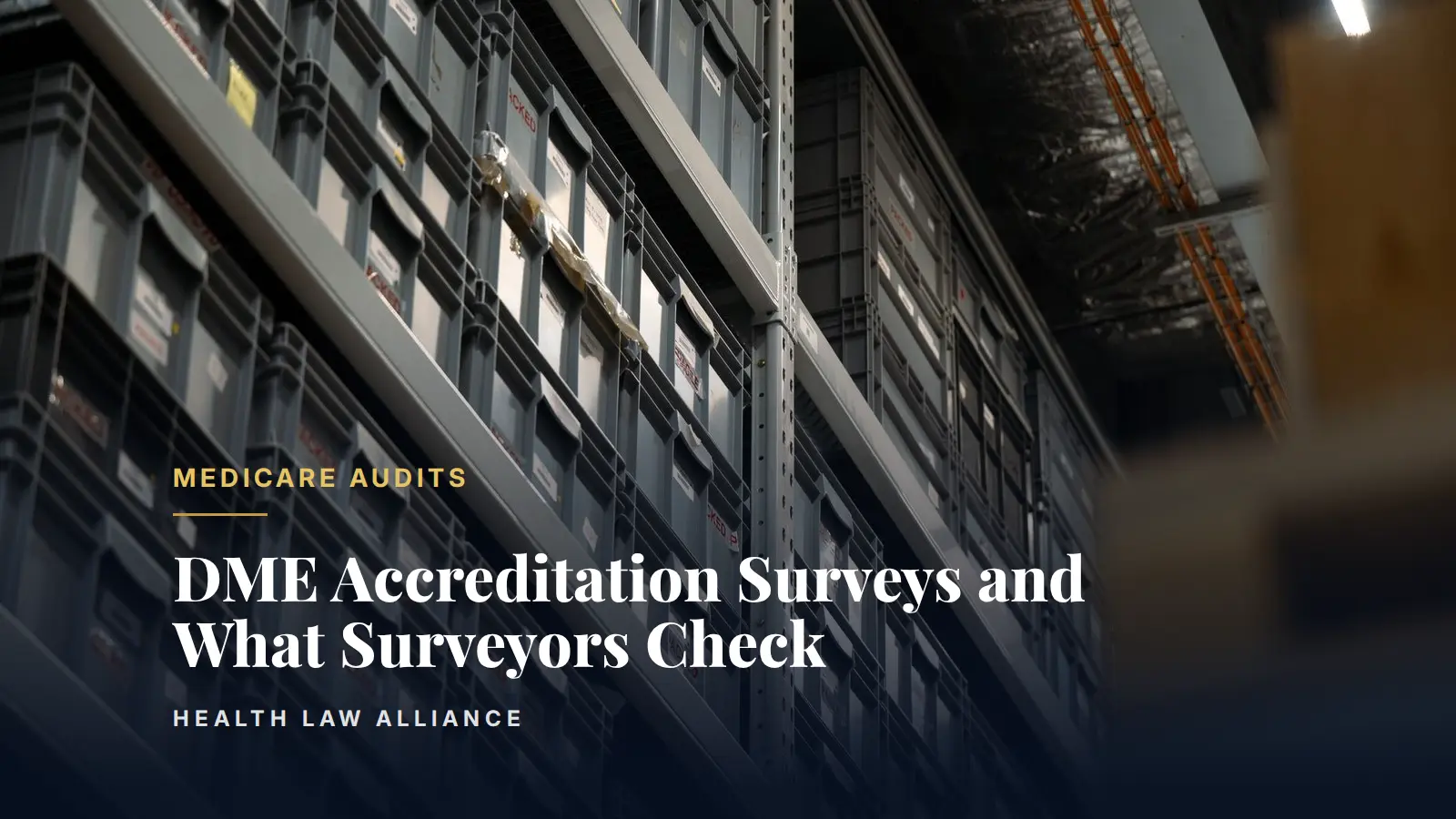
Accreditation by a CMS-approved accrediting organization is a condition of Medicare enrollment itself under 42 CFR 424.57(c)(22). A failed or lapsed survey can trigger denial or revocation of Medicare billing privileges under 42 CFR 424.535. Surveyors check the same facility, delivery, and complaint-handling standards CMS already wrote into the supplier standards at 424.57(c). A gap any surveyor flags is a gap CMS can act on independently of the survey itself.
The DMEPOS Accreditation Requirement
Most suppliers of durable medical equipment, prosthetics, orthotics, and supplies, DMEPOS, must be accredited by an independent accrediting organization CMS has approved under 424.58 before they can receive or keep a Medicare billing number, per 424.57(c)(22)(i). CMS's current list of approved accrediting organizations includes the Accreditation Commission for Health Care (ACHC), the Community Health Accreditation Program (CHAP), the Healthcare Quality Association on Accreditation (HQAA), The Compliance Team, The Joint Commission, and the Board of Certification/Accreditation (BOC). The accreditation itself must name the specific products and services the supplier is accredited to furnish, and every DMEPOS location needs its own, including a subcontracted location. A DMEPOS supplier billing through a contractual arrangement with a parent entity under 42 CFR 424.80(b)(2) still carries the audit and overpayment exposure described in Reassignment of Medicare Benefits: Where Groups Get Exposed, separate from the accreditation duty above.
What DMEPOS Surveyors Check
A DMEPOS survey works through the enumerated standards at 424.57(c) one at a time. On the facility side, surveyors confirm the practice location meets the minimum size and signage requirements, is accessible to Medicare beneficiaries, and posts its hours of operation, per 424.57(c)(7). On the documentation side, they check that the supplier maintains proof of delivery for every covered item under 424.57(c)(12) and supporting documentation for the ordering and referring provider under 424.57(c)(28). Surveyors also review the supplier's written complaint resolution protocol and its log of beneficiary complaints under 424.57(c)(19) and (c)(20), confirm any required state drug-dispensing license under 424.57(b)(4), and verify a liability insurance policy of at least $300,000 under 424.57(c)(10).
Each DMEPOS location must independently meet the quality standards and hold its own accreditation before Medicare will pay a claim billed from that address.
How a Failed Survey Reaches Enrollment Status
424.57(c)(22)(iii) lets CMS deny enrollment, or revoke an accredited supplier's billing privileges outright, when it determines the supplier fails the DMEPOS quality standards. 424.535(a)(23) supplies the enrollment-side mirror: a DMEPOS supplier's non-compliance with any provision of 424.57(c) is itself a stated ground for revocation. The effective date follows the accreditation action itself. Under 424.535(g)(2)(xv)(A), a revocation tied to the suspension, revocation, or termination of the supplier's accreditation is effective on the date that action took place. A supplier revoked on these grounds also faces a reenrollment bar of one to ten years under 424.535(c)(1), and up to twenty years under 424.535(c)(3) for a second revocation. Reactivation, discussed in Reactivating a Deactivated Medicare Billing Number, applies to a deactivated number, not a revocation; a revoked DMEPOS supplier must wait out the reenrollment bar and submit a new enrollment application.
Accreditation Precedes Ongoing Medicare Review
Accreditation is the admission ticket into Medicare billing. CMS's scrutiny continues well after enrollment. A DMEPOS supplier's claims then sit inside the same Medicare audit defense exposure that follows every enrolled provider. RAC audits are the clearest example: they apply extrapolation to a sampled claim set and convert a handful of documentation gaps into a recoupment demand far larger than the sample itself. Those post-payment denials can trace back to the governing local coverage determination for the item billed, coverage criteria that a post-payment audit tests separately from the survey standards above.
Why early legal counsel is critical: it is critical that DME suppliers retain experienced healthcare defense counsel promptly after a survey finding, an accreditation deficiency notice, or any CMS correspondence questioning enrollment status. Early legal intervention can protect the supplier's rights, shape the response to the accrediting organization and to CMS, preserve defenses before a revocation becomes final, and allow counsel to communicate with CMS and the accrediting organization on the supplier's behalf. Delaying representation narrows the options available once a retroactive revocation date is already set.
How Health Law Alliance can help: Health Law Alliance defends DME suppliers through accreditation survey findings, enrollment denials, and revocation actions under 424.57 and 424.535, including the appeal process when CMS imposes a retroactive effective date or a reenrollment bar.
Health Law Alliance's attorneys have overseen 2,000+ audits and handled 5,000+ matters, with 25+ years of experience.
If a DMEPOS survey finding or an accreditation deficiency notice has put your billing privileges at risk, contact Health Law Alliance for a free, confidential consultation to review the survey record and the enrollment exposure it carries.