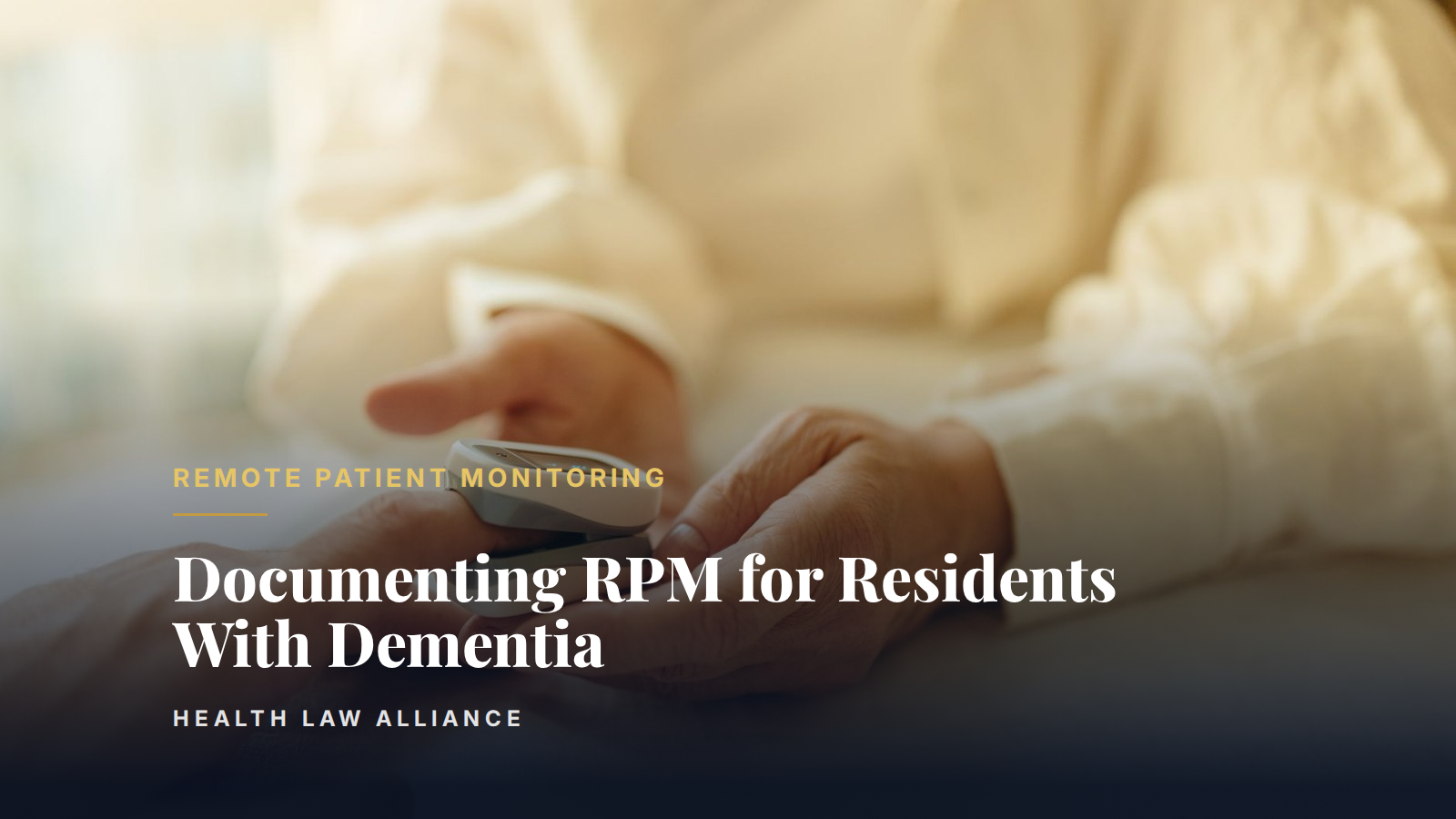
A resident with moderate to severe dementia cannot consent to remote patient monitoring and cannot hold the real-time conversation CPT 99457 requires each month, so a physician managing that resident's RPM has to solve both problems in the chart before the service is billed. The Department of Health and Human Services Office of Inspector General found in September 2024 that 43 percent of Medicare enrollees receiving remote patient monitoring did not receive all three billed components, and raised its own fraud concerns about the service. For a nursing facility resident who communicates only through a caregiver, the consent record and the interactive communication log are the two places an auditor looks first.
Consent From Residents Who Lack Capacity
Medicare requires documented patient consent before or at the start of remote physiologic monitoring. When a resident cannot give that consent because of dementia or another condition affecting capacity, the practitioner needs a legally authorized representative in that resident's place, not a family member who simply answers the phone. State law, not Medicare policy, decides who qualifies: a named health care agent under a power of attorney, a court-appointed guardian, or the surrogate a state's health care consent statute designates by default when no document exists. That hierarchy differs by state, so the chart should name the specific legal basis for the representative's authority rather than note only that the family consented.
Interactive Communication Under CPT 99457 When the Resident Cannot Converse
CPT 99457 is built for exactly this situation. The code's own descriptor requires at least one real-time interactive communication with the patient or caregiver during the billed month, not with the patient alone. A caregiver call, whether with a family member or a facility staff member acting in that role, can satisfy the requirement for a resident who cannot hold the conversation, because the code names patient and caregiver as alternatives rather than ranking one above the other. What the descriptor does not excuse is the record of that call. The chart entry has to show that the required real-time interactive communication actually took place during the month, logged against the 20 minutes of clinical staff or practitioner time the code also requires.
CPT 99457 requires a real-time interactive communication with the patient or caregiver every billed month, and a caregiver call logged only as placed, with no record that the interactive communication actually took place, does not satisfy that requirement.
What an Auditor Looks For in RPM Documentation
The OIG's September 2024 review lines up with what a Medicare contractor checks in an individual claim file. The report found Medicare often lacks basic information about who ordered the monitoring, and that an incomplete or undocumented component, education and setup, device supply, or treatment management, is common enough to warrant its own recommendation. For a dementia resident's file, that translates into four checks: the consent document and who signed it, the practitioner's note establishing the condition and the monitoring order, the device data showing the required collection days, and the interactive communication log for every billed month of 99457.
A program integrity contractor, including a Unified Program Integrity Contractor (UPIC), reviewing a facility's RPM claims treats a missing or vague communication log the same way it treats missing consent, as grounds for a recoupment demand on every month billed that way. A pattern of billed months with no documented interactive communication can also raise False Claims Act exposure, because each claim certifies that a service with specific statutory elements was actually furnished. Place of service coding belongs in the same file: a facility resident's Part A or Part B status on the date of service has to match the claim.
Health Law Alliance's attorneys have overseen 2,000+ audits and handled 5,000+ matters, with 25+ years of experience.
Why Early Legal Counsel Is Critical
It is critical that physicians and facilities promptly retain experienced healthcare defense counsel upon receiving an audit notice, document request, or other government inquiry involving remote patient monitoring claims for residents who lack capacity. Early legal intervention can help structure an accurate response to the contractor's request, help avoid admissions that narrow the practice's defenses later, and preserve the practice's ability to appeal. Delaying representation until after the response deadline passes can significantly narrow these options.
How Health Law Alliance Can Help
Health Law Alliance's remote patient monitoring audit defense attorneys represent physicians and facilities nationwide in RPM audits, including matters involving residents who lack capacity to consent or converse. If your practice has received an audit notice or document request involving RPM claims, contact Health Law Alliance's remote patient monitoring audit defense attorneys for a free, confidential consultation.