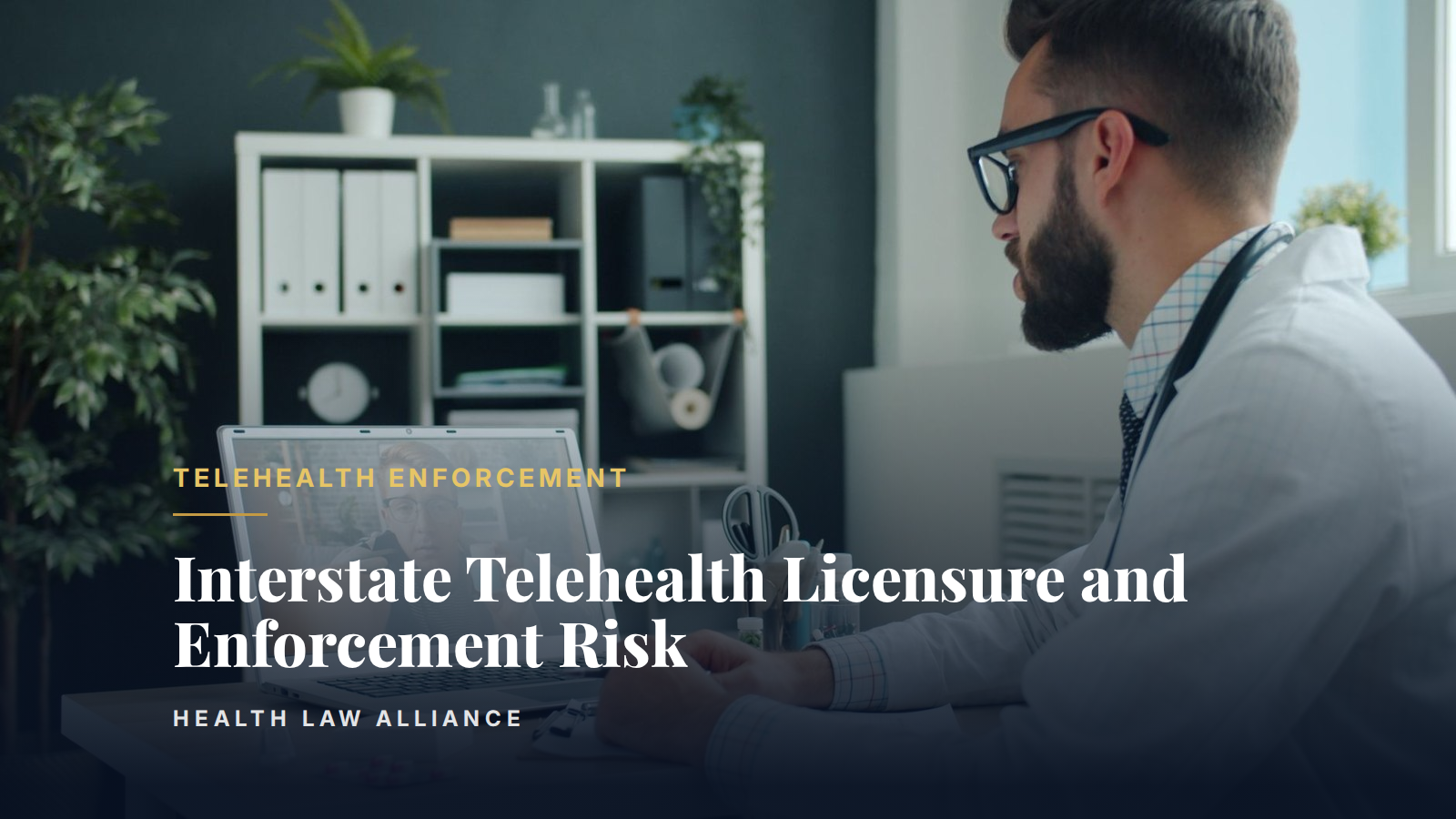
A telehealth provider licensed in one state can still face unlicensed practice of medicine exposure the moment a patient logs in from another state. Every state medical board applies the same baseline: the practice of medicine occurs where the patient is physically located, not where the clinician sits. Interstate telehealth licensure is now its own enforcement category, reaching board discipline, criminal unlicensed-practice statutes, and the billing side of a claim once a payor or a UPIC contractor asks where the care was actually delivered. Licensure compacts narrow the paperwork, not the underlying exposure.
The Patient's Location Controls, Not the Provider's
A license in the provider's home state authorizes treatment in that state. It does not extend to a patient who is physically present somewhere else during the encounter, including a patient who travels, relocates, or simply logs in from a second home. State boards have disciplined out-of-state physicians on exactly that fact pattern, and at least one state's telehealth licensing law has survived a constitutional challenge built on it. HLA's Practicing Across State Lines covers that ruling and the board-discipline mechanics in full. The rule itself is simple to state and gets violated often: verify the patient's location before the visit, not after a board inquiry arrives.
What Licensure Compacts Do and Do Not Solve
The Interstate Medical Licensure Compact now covers roughly 40 member states, and speeds up the process of obtaining a separate license in each one. It does not replace the individual license. A physician using the compact still holds a distinct license in every state where a patient sits, and remains subject to that state's board. Nurses have a parallel pathway through the Nurse Licensure Compact, and psychologists through PSYPACT, but eligibility and participating states differ by compact. Treating compact membership as a single nationwide license, rather than a faster path to a state-by-state one, is the mistake most likely to surface during an audit rather than before one.
Unlicensed Practice Carries Criminal Exposure, Not Just Board Discipline
Practicing medicine, nursing, or psychology without the license the patient's state requires is a criminal offense in most states, ranging from a misdemeanor to a felony depending on the state, separate from and in addition to board discipline. A platform that schedules encounters without confirming where the patient will be sitting, discussed further in Telehealth Platform Agreements, can expose the platform and the clinician together. Referral or marketing arrangements layered on top of an interstate practice can separately implicate the anti-kickback statute, a distinct risk covered in Marketing Arrangements in Telehealth.
The Billing Side: False Claims Act and Recoupment Exposure
A claim billed for a visit the clinician was not licensed to provide in the patient's state can itself become a false claims act problem, because a valid license in the state of treatment is generally a condition of a payor recognizing the claim at all. The DOJ and HHS reestablished a joint False Claims Act Working Group in July 2025 to apply data analytics across large claims sets, the kind of cross-state pattern a licensure gap creates. Once a payor or a UPIC contractor flags it, the immediate consequence is usually a recoupment demand across every claim tied to the unlicensed encounters, well before any criminal referral is decided.
The patient's location controls the licensure question, and it controls the billing question the same way, because both ask where the care was actually delivered.
Reducing Exposure Across State Lines
Providers running a genuinely interstate practice need a documented process, not an assumption: confirm and record the patient's physical location at intake for every visit, and hold an individual license or a verified exemption in that state before the visit occurs. The same intake record that protects against a licensure finding is the record a payor pulls first if a claim is later questioned, which is why the two exposures are best managed together.
Why Early Legal Counsel Is Critical
It is critical that telehealth providers and platforms retain experienced healthcare defense counsel before expanding into new states, and immediately upon receiving a board inquiry, subpoena, or payor audit letter tied to cross-state practice. Early legal review can confirm which compact pathways actually apply, correct intake and documentation gaps before they compound across hundreds of claims, and preserve defenses that are far harder to raise once a board or a payor has already built its case.
How Health Law Alliance Can Help
Health Law Alliance has overseen 2,000+ audits and represented 2,500+ clients across healthcare regulatory and enforcement matters nationwide, including telehealth providers and platforms operating across multiple states. If your practice treats patients outside the state where your clinicians are licensed, our telehealth law and telemedicine attorneys can review your licensure posture before a board or a payor reviews it for you.