
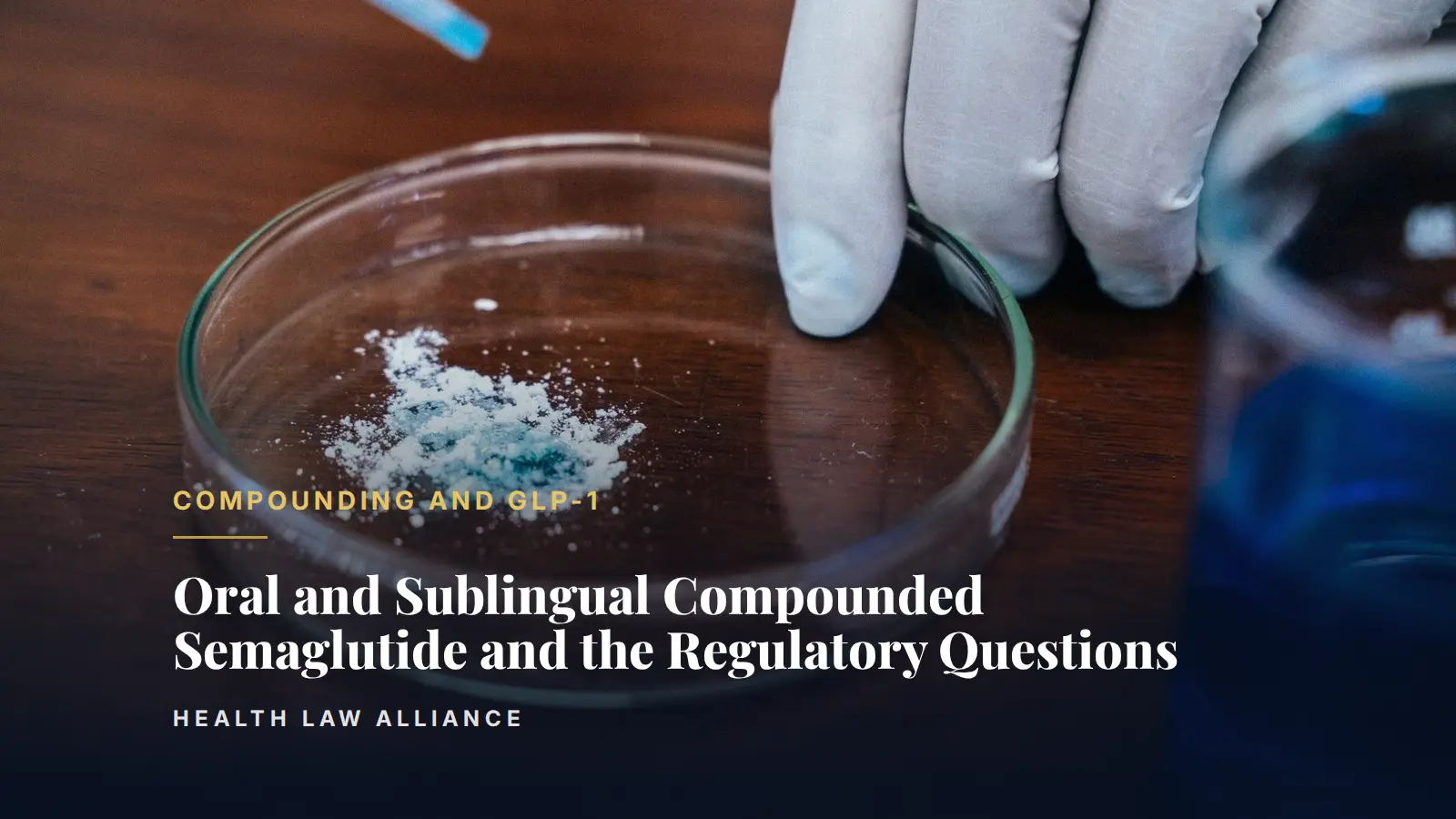
Compounding pharmacies are fielding more prescriber requests for sublingual drops, oral troches, and other non-injectable semaglutide preparations, pitched as alternatives to compounded injectable semaglutide. In a Federal Register notice published May 1, 2026, the Food and Drug Administration (FDA) proposed not to add semaglutide to the 503B bulks list for any route of administration, including the oral and sublingual forms the nominations specifically requested. The same notice walked through how little evidence exists that a non-injectable compounded version reaches the bloodstream at all, a gap that is the legal exposure for a pharmacy filling a sublingual order today.
Three Routes, One FDA Determination
The nominations FDA evaluated proposed compounding semaglutide as a subcutaneous injection, an oral tablet or capsule, and a sublingual or buccal product. Docket No. FDA-2018-N-3240 (91 FR 23431) asked, for every route, whether an attribute of the FDA-approved products makes them medically unsuitable for a specific group of patients, and whether the compounded product would address that attribute. FDA found that the nominations did not clear that threshold for any route, including the sublingual and buccal forms nominators said were needed for patients who have trouble swallowing a tablet or tolerating an injection. Comments, after an extension, closed July 30, 2026, and the determination remains proposed, not final.
FDA applied a similar bulk-substance evaluation to another compounded peptide; see BPC-157 and Compounding: The Regulatory Position.
Bioavailability Drives the Legal Exposure
FDA's notice states that the estimated absolute bioavailability of its approved oral semaglutide tablets is only about 0.4 to 2 percent, tied to a co-formulated absorption enhancer, salcaprozate sodium (SNAC), built into the approved tablet's specific formulation. A compounded sublingual drop, troche, or dissolving tablet that does not replicate that formulation has not been shown, in any study FDA cited, to deliver a comparable dose into the bloodstream. A pharmacy that represents such a product as equivalent to the approved tablet is making a quality and labeling claim the compounding record does not support.
FDA's notice found that its approved oral semaglutide tablets depend on an absorption enhancer built into their specific formulation, one that no nomination it evaluated showed how a compounded product would replicate.
The 503A and 503B Limits on a Bulk Pathway
Compounding pharmacies operate under two statutory tracks, 503A/503B, each with its own rules for sourcing a bulk drug substance. Section 503A conditions the exemption on sourcing that substance one of three ways: an applicable USP monograph, status as a component of an FDA-approved drug, or inclusion on a separate 503A bulks list. Semaglutide is the active ingredient in FDA's approved semaglutide products, the pathway that lets a 503A pharmacy compound it for an identified patient without its own bulks-list entry, provided the result is not essentially a copy of the commercial drug unless the prescriber documents a significant difference for that patient.
Section 503B, unlike 503A, is not exempt from cGMP requirements, and an outsourcing facility may use a bulk substance only if it sits on the 503B bulks list or the finished drug is on FDA's drug shortage list at the time of compounding. FDA's proposed refusal to list semaglutide leaves outsourcing facilities without a bulk pathway for oral or sublingual production whenever the shortage list does not apply.
Stability Questions USP Governs, Not the Prescriber
Oral and sublingual semaglutide preparations are non-sterile, governed by the United States Pharmacopeia's General Chapter <795>, revised effective November 1, 2023. The default beyond-use date for a nonpreserved aqueous oral solution is 14 days, 35 days if preserved, and 90 days for a nonaqueous oral liquid; a longer date requires stability data specific to that preparation, not the commercial tablet's expiration date. Assigning a beyond-use date without that preparation-specific support is the documentation gap an FDA inspection or a state board complaint is built to find.
Why Early Legal Counsel Is Critical
It is critical that compounding pharmacies and the prescribers who order from them retain experienced healthcare defense counsel promptly upon receiving an FDA Form 483, a warning letter, or a state board of pharmacy inquiry tied to oral or sublingual semaglutide. Early legal intervention can protect the pharmacy's rights, shape the record on bulk-substance sourcing and beyond-use-date support before an inspection narrative hardens, avoid inadvertent admissions during the records exchange, and allow counsel to communicate with investigators on the pharmacy's behalf. Delaying representation can affect the outcome of the matter.
How Health Law Alliance Can Help
Health Law Alliance has represented 2,500+ clients nationwide. If your pharmacy has received an inspection finding, a warning letter, or a records request tied to oral, sublingual, or other non-injectable semaglutide compounding, contact Health Law Alliance's compounding pharmacy attorneys for a free, confidential consultation before you respond.