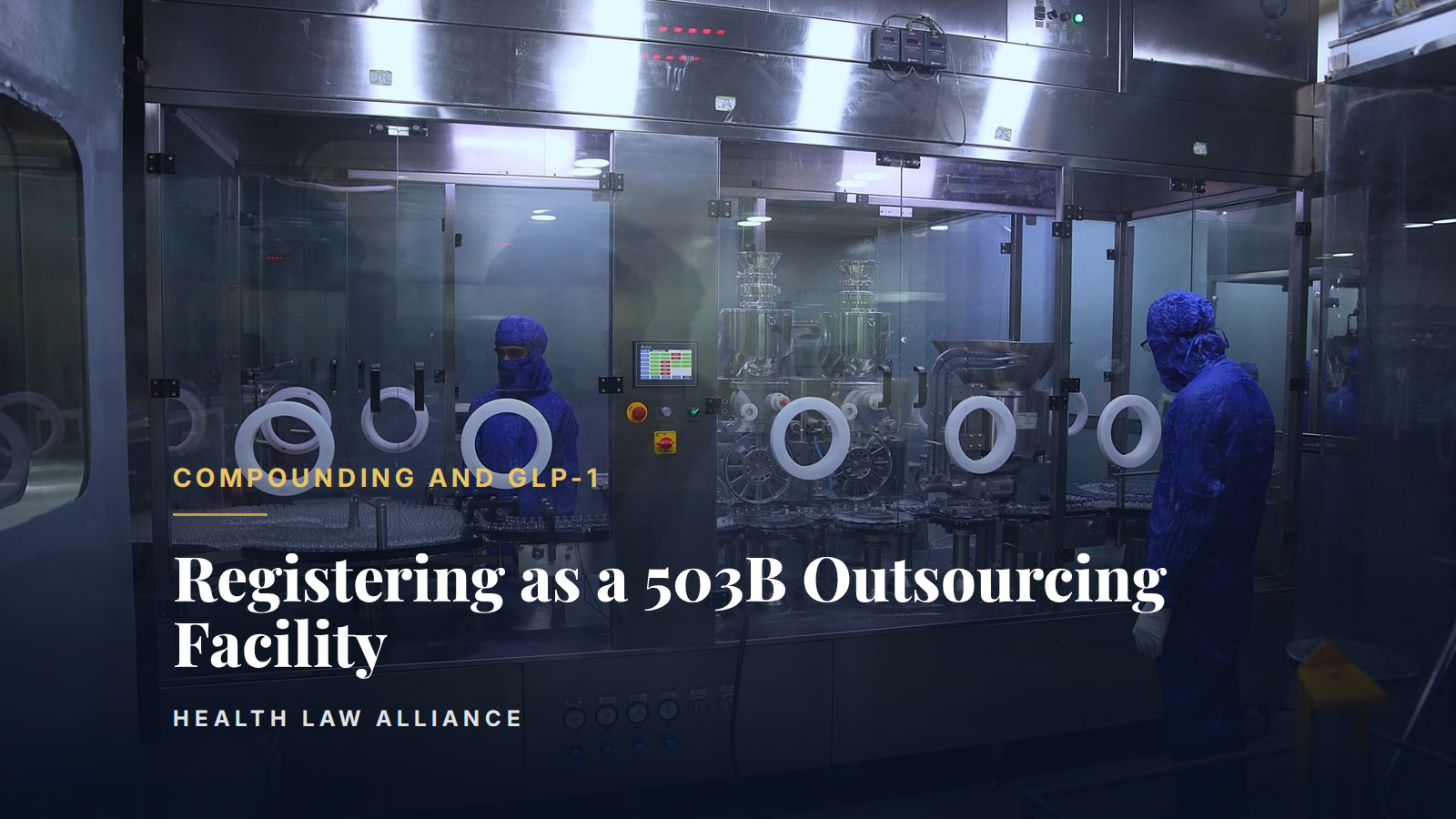
A compounding pharmacy that wants to sell without patient-specific prescriptions, ship across state lines at scale, or supply hospitals and clinics directly must register with the FDA as an outsourcing facility under Section 503B of the Food, Drug, and Cosmetic Act. The registration itself is a short electronic filing. What follows it is not: a facility that registers as 503B leaves the USP 797/800 and state board of pharmacy framework that governs 503A compounding and takes on manufacturing obligations under current good manufacturing practice (cGMP) rules, along with routine FDA inspection. Converting carries real regulatory exposure if the facility registers before its operations can support cGMP compliance.
Who Registers and Why
Section 503B, added to the FD&C Act by the Drug Quality and Security Act of 2013, lets a compounder elect to register with FDA as an outsourcing facility. Registration is voluntary, and an outsourcing facility does not need to hold patient-specific prescriptions to compound and ship a drug. That is the core commercial reason pharmacies convert: 503A compounding generally requires a prescription tied to an identified patient, while a 503B facility can compound in batches ahead of demand and distribute nationally. In exchange, its products are exempt from FDA's new drug approval process and certain labeling requirements, but not from cGMP.
The Registration Mechanics
Initial registration is filed electronically with FDA and requires the facility's name, place of business, a unique facility identifier, a point of contact, and disclosures of whether the facility intends to compound a drug on FDA's shortage list and whether it compounds from bulk drug substances. A facility is not considered registered until its annual establishment fee has been paid. After the first year, a registered outsourcing facility must re-register every year during the window FDA opens between October 1 and December 31. Missing that window lapses outsourcing status until re-registration, which can interrupt supply agreements built on 503B-exempt product. Registered facilities also report compounded drug products to FDA twice a year, in June and December, for the prior six-month period.
Fees and What They Cover
FDA sets outsourcing facility fees annually under a user fee program funded by the industry it regulates. For fiscal year 2026, the annual establishment fee is $20,726 for a standard facility and $6,829 for a facility that qualifies as a small business, with a separate reinspection fee of $20,486 assessed when FDA returns to close out inspection findings. Small business fee reduction requests run on their own annual filing window, ahead of the establishment fee deadline, and the fee recurs every year rather than as a one-time charge.
The cGMP Obligation 503A Pharmacies Do Not Carry
The dividing line between the two frameworks is compliance obligation, not just registration. A 503A pharmacy is regulated primarily by its state board of pharmacy under USP 795, 797, and 800 standards. A registered outsourcing facility is regulated by FDA under cGMP requirements in 21 CFR Parts 210 and 211, the framework FDA applies to conventional drug manufacturers, and it faces routine FDA inspection on a risk-based schedule rather than periodic state board inspection. That includes written batch production records, environmental monitoring, formal stability support for labeled beyond-use dates, an independent quality control unit, and adverse event reporting to FDA.
Registering as a 503B facility trades a prescription-by-prescription compliance model for a manufacturing compliance model, and FDA inspects accordingly.
Weighing the Conversion
The business case for 503B status is strongest for a pharmacy already compounding in volume for institutional customers, already facing beyond-use date limits under 503A that constrain batch production, or positioned to sell nationally without a patient-specific prescription for each unit. The case against conversion is the fixed cost of cGMP infrastructure: validated cleanrooms, a dedicated quality unit, batch documentation systems, and staff trained to a manufacturing standard, on top of the annual fee. A facility that registers without that infrastructure is registering into an inspection program it is not ready for.
Why Early Legal Counsel Is Critical
It is critical that a pharmacy evaluating 503B registration retain experienced healthcare defense counsel before filing, not after FDA opens its first inspection. Early legal involvement can assess whether operations can sustain cGMP compliance, structure the conversion timeline against the annual registration window, and flag gaps in documentation and quality systems while they can still be corrected. Registering before that assessment is complete can expose the facility to findings that follow it into every later inspection.
How Health Law Alliance Can Help
Health Law Alliance advises compounding pharmacies nationwide on 503A and 503B frameworks, from registration decisions through cGMP compliance builds and FDA inspection response. Our related coverage on how 503A and 503B frameworks differ and USP 797/800 inspection readiness walks through the groundwork a facility needs before registering. If your pharmacy is weighing 503B conversion, contact us for a free, confidential consultation.