A subpoena from a state medical board or board of pharmacy for a patient's chart usually follows an earlier letter or complaint notice, and it starts a clock: a return date, a defined set of records, and consequences for producing nothing. How a physician responds in the days after receipt, before anything is disclosed, often shapes the board's finding more than the underlying care itself.
Confirm the Board's Authority and the Request's Scope
A licensing board's subpoena power comes from the state practice act, and it is real but not unlimited. Confirm the subpoena was issued by the board or an investigator acting under its authority, and that the case number and patient names match a complaint on file. A board subpoena is administrative process tied to a licensure inquiry, not a target letter signaling a personal criminal target, though a records dispute can escalate that way; Criminal Charges and Your Professional License covers that escalation. It is also a different track from a continuing education audit, which reviews credit hours rather than patient charts.
Calendar the Return Date and Narrow an Overbroad Demand
Calendar the return date the day the subpoena arrives, not the week before it is due. If the request sweeps beyond the patients, dates, or record types named in the complaint, put a specific, timely written objection on record and ask the board to narrow the scope to the matter actually under review. Silence past the return date, by contrast, converts a records question into a non-compliance finding that stands apart from the original complaint.
Privacy Rules Do Not Block a Lawful Board Request
Neither HIPAA nor most state confidentiality statutes give a physician grounds to withhold records from a licensing board acting within its authority. Under 45 CFR Section 164.512(d), a covered entity may disclose protected health information to a health oversight agency, which includes a state licensing board, for oversight activities authorized by law, expressly including licensure and disciplinary actions, without patient authorization. The disclosure is still limited to the minimum necessary to satisfy the request, and records covered by 42 CFR Part 2 for substance use disorder treatment carry added confidentiality steps. Board subpoena procedure is not uniform nationwide, so any state-specific rule should be confirmed before production.
Produce a Complete, Indexed Set and Keep a Copy
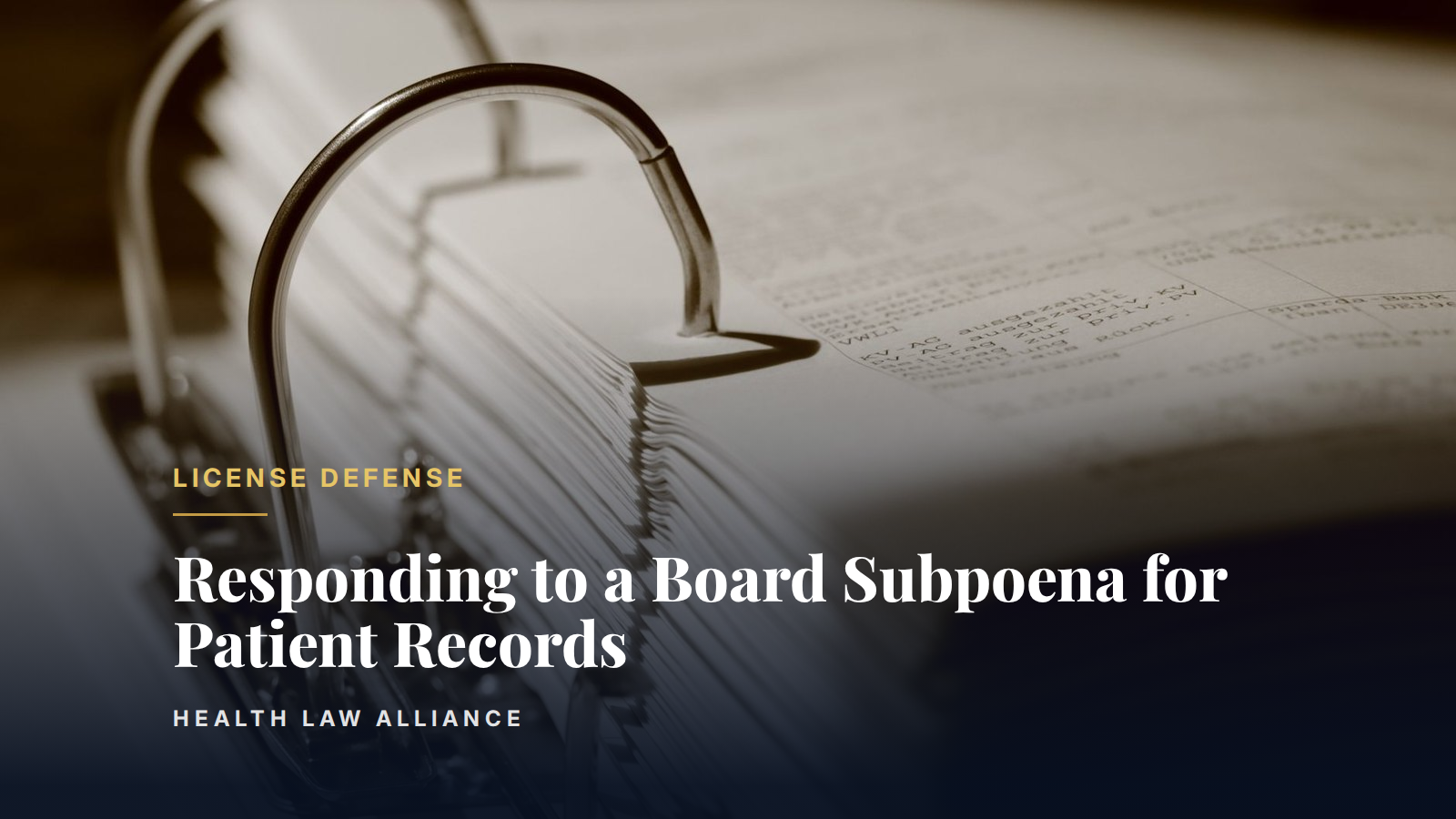
Produce the records as a complete, indexed set: numbered pages, a cover letter identifying what is enclosed by date range and record type, and confirmation of what was withheld and why. Keep an identical copy of the entire production, cover letter included, in the practice's own file. A board's later claim that a note was never produced is easier to answer with a dated, indexed copy in hand than with a memory of what was sent.
A dated, indexed copy of exactly what was sent is often the only proof that a later gap in the board's file was the board's, not the practice's.
The Single Act That Turns a Records Dispute Into a Discipline Case
Altering a note, backdating an entry, or filling in a chart after the subpoena arrives is the one response that reliably converts a records dispute into an independent discipline case. Boards treat post-notice alteration as a separate violation from whatever the complaint alleged, and where a federal inquiry is also involved, altering a subpoenaed record can implicate 18 U.S.C. Section 1519, the federal statute criminalizing alteration or falsification of a record with intent to obstruct a matter within a federal agency's jurisdiction, punishable by up to twenty years' imprisonment. A chart that reflects a documentation lapse should be produced as it exists, with any addendum dated as an addendum, never inserted into the original entry. That is why consent order negotiations later in the matter start from a materially worse position once alteration is on the table.
Why Early Legal Counsel Is Critical
It is critical that physicians promptly retain experienced healthcare defense counsel upon receiving a board subpoena for patient records. Early legal intervention can confirm the board's authority and the request's actual scope, object to overbroad demands before the return date rather than after, and make sure production is complete and indexed rather than assembled under pressure. Delaying counsel raises the odds that an ordinary records request hardens into a non-compliance or alteration finding that has nothing to do with the care at issue.
How Health Law Alliance Can Help
Health Law Alliance has handled 5,000+ matters across healthcare regulatory and license defense over 25+ years, including board subpoenas for patient records. A discipline finding on a records issue can carry consequences beyond the original complaint, including OIG exclusion and network termination. If your board has subpoenaed patient records, contact Health Law Alliance's professional license defense attorneys for a free, confidential consultation before the return date passes.