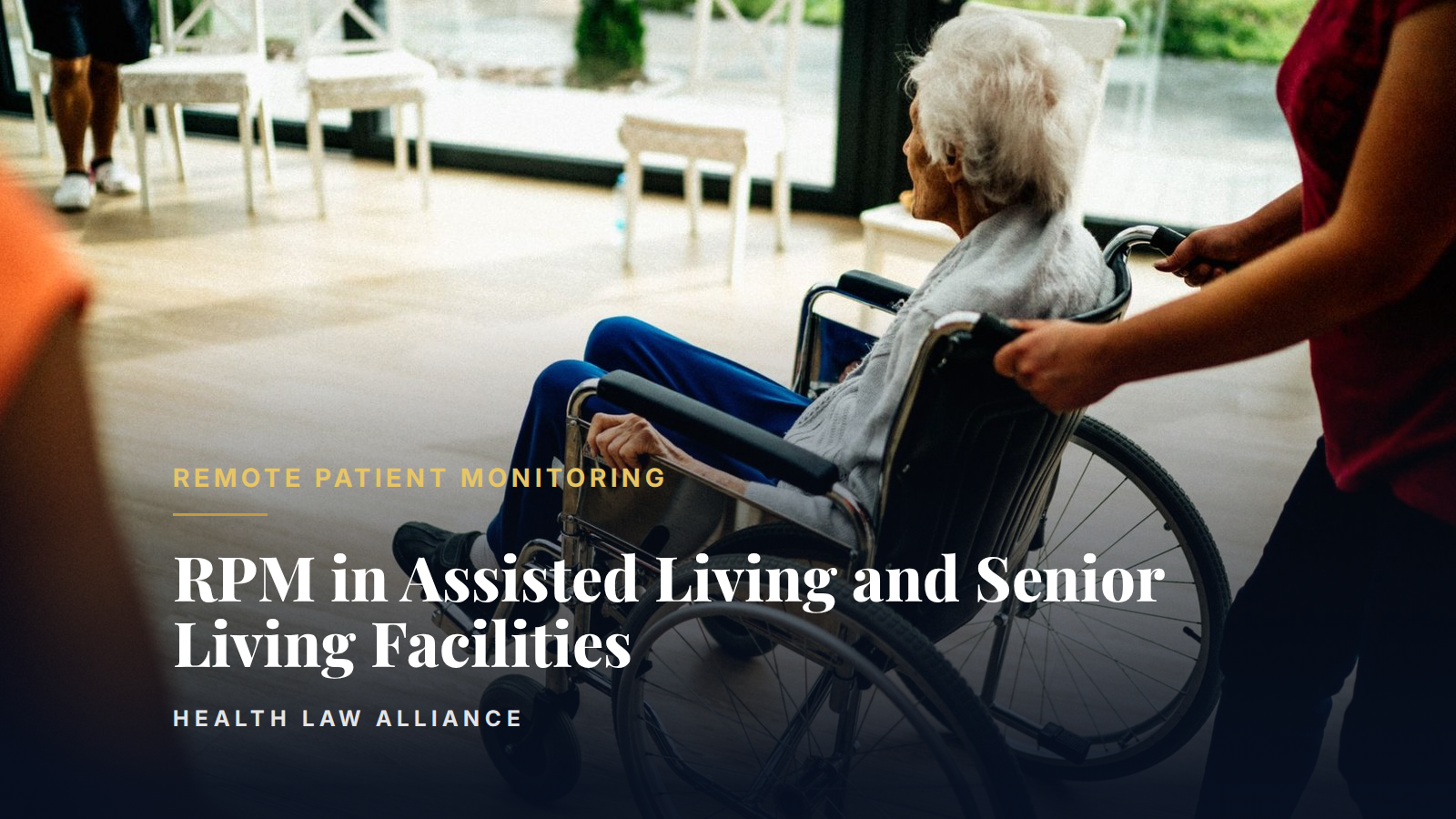
Remote patient monitoring devices are reaching residents in assisted living, independent living and memory care communities, settings that are not Medicare-certified skilled nursing facilities and where the resident's own apartment, not a nursing station, is the place of service. The Department of Health and Human Services Office of Inspector General reported in September 2024 that Medicare enrollees receiving remote patient monitoring grew from about 55,000 in 2019 to more than 570,000 in 2022, with payments rising from $15 million to more than $300 million over the same period. Who may enroll a resident, which place-of-service code applies, and how many days of data a claim needs now turn on rules specific to a resident's living setting.
Billing Remote Patient Monitoring in a Resident's Apartment
Medicare pays for remote physiologic monitoring under the physician fee schedule, not the telehealth benefit, so the place-of-service code is the one matching where the resident actually lives. CMS defines place of service 12 (Home) as a private residence and place of service 13 (Assisted Living Facility) as a congregate residential facility that provides on-site support and arranges some health care, and pays both at the non-facility rate. An assisted living apartment is not a Medicare-certified skilled nursing facility, so the consolidated billing rules that route a skilled nursing stay's services through the facility itself do not reach a resident who lives in assisted living. The billing practitioner still has to be the resident's established treating provider; CMS limits remote physiologic monitoring, unlike remote therapeutic monitoring, to patients with an established patient relationship.
Who Can Enroll a Resident, and Who Cannot
A facility is not a party to the Medicare claim and has no authority to enroll its own residents. CMS requires patient consent before furnishing remote physiologic monitoring, and that consent can be obtained by auxiliary personnel under the billing practitioner's general supervision, not by facility staff acting for a device vendor. The complication in assisted living and memory care is capacity: a resident with a dementia diagnosis may not be able to consent to a program a vendor is marketing in the community's common room, and a durable power of attorney or a state-recognized health care proxy, not the facility administrator, holds authority to consent on that resident's behalf. An arrangement where a facility receives anything of value for steering residents toward a particular vendor is reviewed under the anti-kickback statute, separate from whether any resident's consent was properly obtained.
The 16-Day Threshold Changed for 2026
Through 2025, the device-supply code, CPT 99454, required at least 16 days of transmitted data in a 30-day period to bill. Effective January 1, 2026, CMS finalized new codes 99445 and 99470, one for device supply built on 2 to 15 days of data transmission, and one for the first 10 minutes of treatment management a month, alongside the existing 16-day and 20-minute codes. For residents who may miss daily readings because of a fall, a hospital stay or forgetfulness, the lower threshold removes an old reason some enrollments failed to support a claim, and adds a new question: which threshold, and which code, a given month's data supports.
Assisted living's non-skilled, residential status does not remove any of remote patient monitoring's billing requirements. It changes which place-of-service code applies and who has authority to enroll the resident.
Why Senior Living Is Already Under Review
The same September 2024 report found that 43 percent of Medicare enrollees receiving remote patient monitoring did not get all three billed components, education and setup, device supply, and treatment management, and that for 44 percent of enrollees, Medicare could not identify who ordered the monitoring, because no rule then required the ordering provider's name on the claim. The Office of Inspector General and CMS have both identified remote patient monitoring as a fraud and improper payment risk. A program that enrolls residents through a vendor's presence in a congregate community, rather than through each resident's own treating practitioner, has already built the documentation gap the 2024 report describes before any claim reaches a recoupment demand.
Why Early Legal Counsel Is Critical
It is critical that assisted living and senior living operators, and the practices billing remote patient monitoring for their residents, promptly retain experienced healthcare defense counsel upon receiving an audit notice, a payment suspension, or any other government inquiry. Early legal intervention can protect the provider's rights, ensure an accurate response to the enrollment and consent records a reviewer is entitled to see, avoid inadvertent admissions, and preserve defenses that are only available before a recoupment demand becomes a referral. Delaying legal representation can significantly affect the outcome of a matter and expose the provider to unnecessary risk.
How Health Law Alliance Can Help
Health Law Alliance's remote patient monitoring audit defense attorneys represent physician practices and the monitoring and billing companies that support senior living providers in Medicare review of remote physiologic monitoring claims, including the enrollment, consent and ordering-provider documentation at issue for residents in assisted living and independent living communities. Health Law Alliance's attorneys have overseen 2,000+ audits and handled 5,000+ matters, with 25+ years of experience. If your practice or facility has received an audit notice, a payment suspension, or a request for documentation tied to remote patient monitoring, contact Health Law Alliance's remote patient monitoring audit defense attorneys for a free, confidential consultation.