
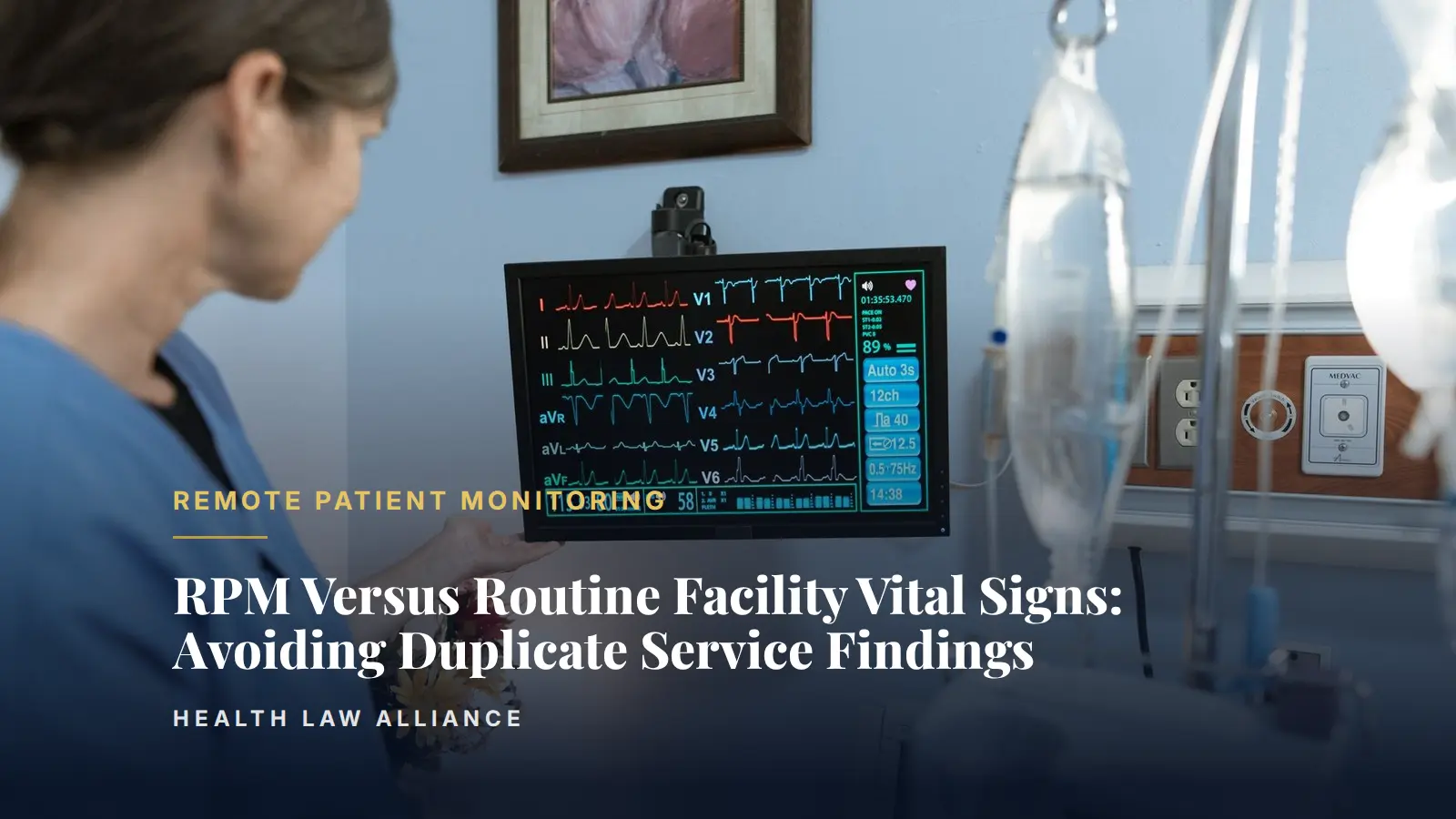
A skilled nursing facility already gets paid for the vital signs its own staff takes. A physician who bills remote patient monitoring (RPM) for the same resident, collecting the same blood pressure and pulse oximetry readings the facility's nurses chart every shift, can be billing Medicare twice for one set of numbers if the RPM claim adds nothing beyond that routine care. Auditors reviewing nursing facility and assisted living referrals treat that overlap as a duplicate-service finding, not just a documentation gap, and the exposure runs from a single claim denial to a recoupment across every resident monitored the same way.
What RPM Billing Actually Requires
Medicare pays remote patient monitoring through a small set of CPT codes: one for patient education and device setup, one for supplying the device and collecting physiologic data across a monitoring window, and two for the clinical time spent reviewing that data each month. Medicare generally allows billing only one device per enrollee each month, and the billing practitioner needs an established relationship with the resident, not a referral arrangement alone. The device must collect and transmit the data on its own; a reading a staff member types in by hand does not qualify. That automatic stream is what separates RPM from the asynchronous telehealth billing covered in Asynchronous Telehealth and Store-and-Forward Billing, where a stored image or recording moves through the system instead.
What the Facility Is Already Paid to Do
Skilled nursing facility residents in a Medicare-covered Part A stay have almost all of their care billed through the facility itself, under a global per diem payment that bundles nearly every service the resident receives, including routine nursing care. Medicare carves physicians' and other practitioners' own professional services out of that bundle, letting an outside practitioner bill Part B directly for a genuine professional service. But CMS has also told facilities and suppliers that a practitioner who, beyond that professional service, also furnishes a service falling inside the bundle is acting as a supplier for that part of the arrangement, not as an excluded professional. A claim that amounts to collecting and transmitting the same vital signs the facility's nursing staff already charts looks less like an excluded professional service and more like a bundled supplier service, which is why the facility, not the practitioner, may be the one already paid for it.
Where Auditors Draw the Line
A facility is already paid to take a resident's vital signs. An audit asks what the remote monitoring claim adds beyond that, not whether the device worked.
The distinguishing facts resemble what a Unified Program Integrity Contractor (UPIC) already looks for in a time-based billing review: a parameter the facility does not routinely chart, transmission on a schedule the nursing station's rounds do not cover, and treatment-management notes showing a clinical response rather than a restatement of the facility's flowsheet. The HHS Office of Inspector General's August 2025 data snapshot on remote monitoring billing found that nearly 90 percent of medical practices never billed the same enrollee alongside two or more other practices, while 34 practices did so for more than 25 percent of their enrollees; OIG said that pattern raises concern the billing covers monitoring that is unnecessary or not provided. The same reasoning reaches an RPM claim duplicating a facility's own charting: repeated billing for a data set someone else already collects is the fact pattern an auditor is trained to isolate.
The Anti-Kickback and False Claims Act Exposure
A duplicate RPM claim carries a second layer of exposure when the referral stream runs through a nursing facility rather than a hospital discharge. An RPM vendor that supplies devices, recruits residents, and shares revenue with the facility raises anti-kickback statute (AKS) questions independent of whether any single claim is defensible. And because an RPM claim implicitly represents that the billed service was reasonable, necessary and not duplicative, a pattern duplicating a facility's own charting can expose the practice to False Claims Act (FCA) liability, including the qui tam suits covered in Whistleblower Suits Against Telehealth Companies, which can originate from staff who first notice the overlap. A UPIC review of a handful of flagged residents can expand quickly once the contractor pulls the full facility census, the pattern behind the escalations covered in When a Telehealth Audit Signals a Criminal Investigation.
Why Early Legal Counsel Is Critical
Physicians and nursing facilities should promptly retain experienced healthcare defense counsel once a payer or contractor raises a duplicate-service question about remote monitoring billed alongside a facility's own vital-signs charting. Early legal intervention can protect the practice's position on the record, make sure any response accounts for what the RPM claim added beyond routine facility care, and preserve the defenses available before a records request becomes a formal demand. Delaying that call can turn a documentation question on a handful of residents into a recoupment demand across the full facility census.
How Health Law Alliance Can Help
Health Law Alliance defends physicians, nursing facilities, and remote monitoring companies when a payer or contractor questions whether an RPM claim duplicates the vital-signs monitoring a facility already furnishes. Health Law Alliance's attorneys have overseen 2,000+ audits and handled 5,000+ matters, with 25+ years of experience. Contact Health Law Alliance's remote patient monitoring audit defense team for a free, confidential consultation on a duplicate-service finding or a facility-wide RPM audit.