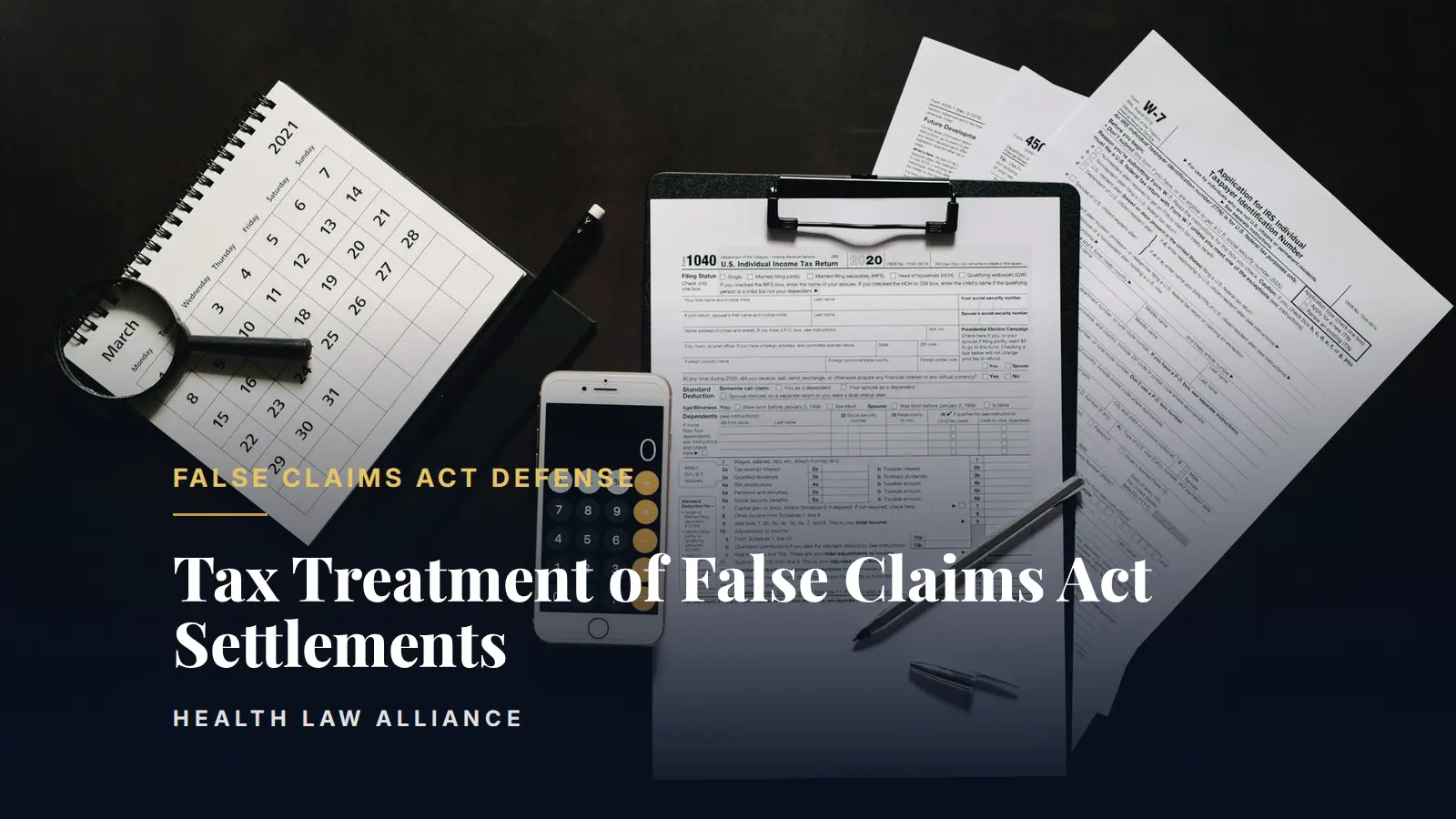
A False Claims Act settlement does not produce an automatic tax deduction. Under Section 162(f) of the Internal Revenue Code, the default rule denies a deduction for any amount a defendant pays to the government in relation to a violation of law, and the exception that can preserve a deduction depends on how the settlement agreement itself describes the payment, not on either side's private understanding of the money. For a compliance officer negotiating a False Claims Act resolution, the tax outcome is fixed inside the document that resolves the underlying liability, before the first payment is made.
The Default Rule Against Deducting Government Payments
Section 162(f)(1) disallows a deduction for any amount paid or incurred, whether by suit, agreement, or otherwise, to or at the direction of a government or governmental entity in relation to the violation of any law, or the investigation or inquiry into a potential violation. Congress rewrote this provision in the 2017 tax law, which applies to amounts paid or incurred on or after Dec. 22, 2017, with an exception for a binding order or agreement entered into before that date. The starting assumption is that the payment is nondeductible, and the exception has to be earned inside the settlement paperwork, not argued afterward on an amended return.
The Two-Part Restitution Exception
Section 162(f)(2)(A) carves out an exception for amounts that constitute restitution, including remediation of property, for damage or harm caused by the violation, or that are paid to come into compliance with the law that was violated. The exception carries two separate requirements. The establishment requirement obligates the taxpayer to prove the payment functions as restitution or a compliance payment. The identification requirement is separate: the court order or settlement agreement itself must state that character on its face. The Internal Revenue Service has been explicit that these are independent tests, and satisfying the identification requirement alone does not satisfy the establishment requirement.
What the Settlement Agreement Must Say
DOJ's own civil settlement agreements already perform the mechanical step the statute requires: they state the total settlement amount and then separately identify the dollar portion of that total that constitutes restitution. That structure is what Section 162(f)(2)(A)(ii) demands, and a settlement that recites only a lump sum, without breaking out the restitution component, leaves the defendant with nothing to point to on the identification requirement. Section 162(f)(2)(B) narrows the exception further: it does not reach any amount paid as reimbursement to the government for the costs of its own investigation or litigation, regardless of how the agreement labels it. Section 6050X then requires the government to report the payment to the IRS, separately stating the restitution portion, and to furnish the same statement to the defendant.
A settlement agreement that calls a payment restitution does not by itself make it deductible. The taxpayer still has to establish that the payment functions as restitution, and the Internal Revenue Service tests the two requirements separately.
Health Law Alliance's attorneys have overseen 2,000+ audits and handled 5,000+ matters, with 25+ years of experience.
Why Characterization Gets Contested
A civil False Claims Act settlement routinely resolves exposure that is not purely compensatory. The statute itself authorizes treble damages and a separate civil penalty for each false claim, and a release that compromises both kinds of exposure in a single number invites a dispute over how much of the total is restitution and how much is punitive. The qui tam posture common to these matters adds another layer, since a relator's share is paid out of the same settlement fund, and the agreement has to account for that allocation without disturbing the restitution identification the defendant needs for its own return. A corporate integrity agreement negotiated alongside the monetary settlement, and any OIG exclusion exposure do not change the tax analysis, but both are often negotiated in the same sequence of drafts, which is another reason the restitution language belongs in the settlement agreement itself, not a side letter.
Why Early Legal Counsel Is Critical
It is critical that healthcare providers promptly retain experienced healthcare defense counsel before executing a False Claims Act settlement agreement. Early legal intervention can confirm the restitution language tracks the underlying facts and avoid a release that compromises the deductible and nondeductible portions of the payment into one undifferentiated number. The court order or settlement agreement is the only document Section 162(f)(2)(A)(ii) looks to.
How Health Law Alliance Can Help
Health Law Alliance represents healthcare providers negotiating False Claims Act resolutions, including the settlement language that determines whether a payment can be deducted under Section 162(f). Providers facing a settlement can contact Health Law Alliance through its False Claims Act defense practice for a free, confidential consultation, and providers assessing related exposure can review Insurance Coverage for FCA Defense Costs, Materiality as a Defense: Government Knowledge, and Medically Unnecessary Services as an FCA Theory.