
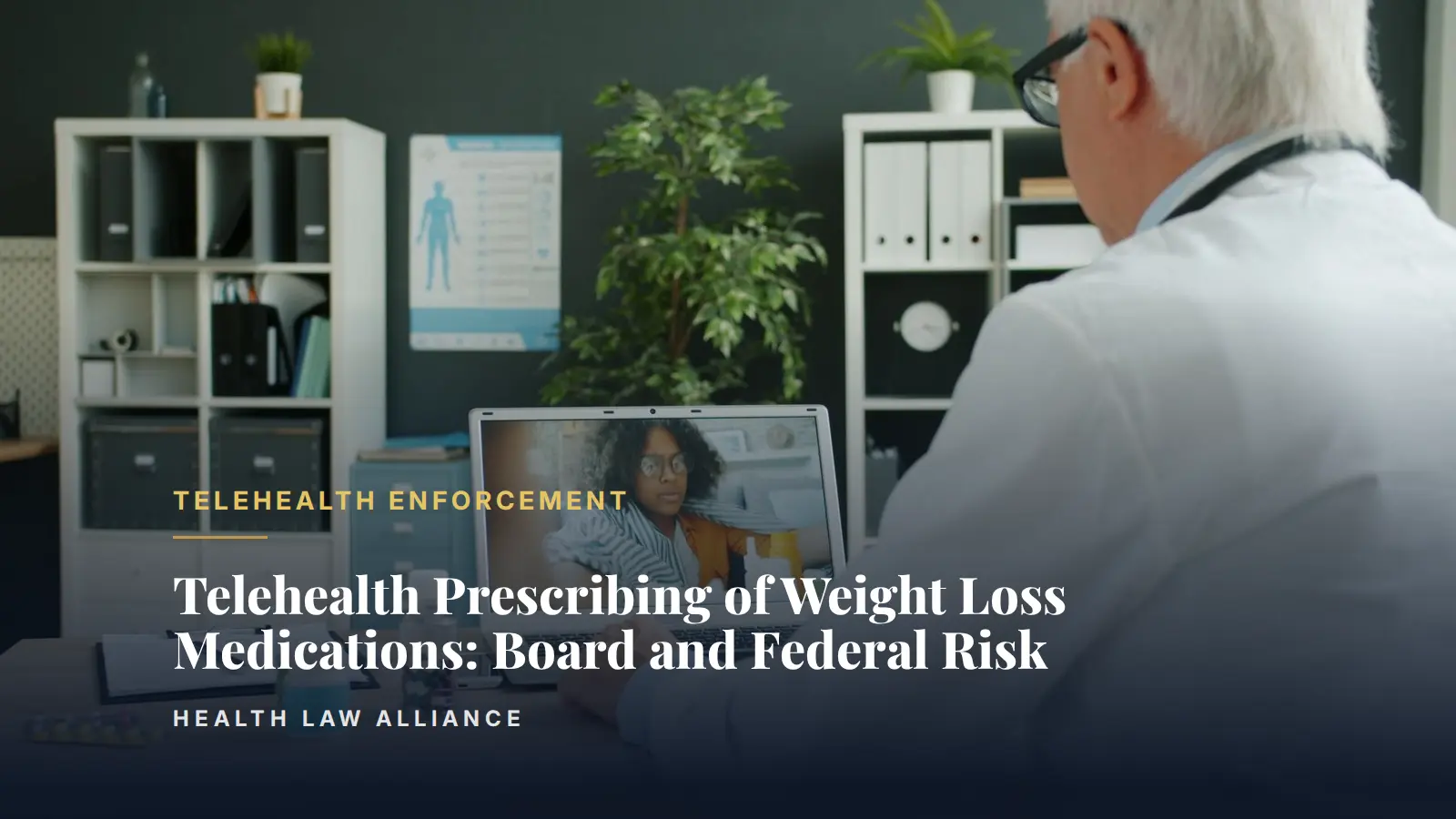
Telehealth prescribing of GLP-1 class medications for weight loss has drawn scrutiny from state medical boards, the Drug Enforcement Administration (DEA), the Food and Drug Administration (FDA) and the Federal Trade Commission (FTC) at once. A thin patient evaluation, a compounded product sourced outside current rules, or a weight-loss advertising claim that outruns the evidence can each draw an inquiry on its own. Together, the three issues shape how a board complaint or a federal investigation reads a telehealth prescribing program.
Patient Evaluation Standards Still Apply to a Screen
State medical and osteopathic boards do not relax the standard of care because the visit happened by video or a questionnaire. A telehealth evaluation for a GLP-1 class medication still has to document a weight and medical history, current medications, and known contraindications such as a personal or family history of medullary thyroid carcinoma. Boards auditing a telehealth program expect evidence that a licensed prescriber, not an intake form alone, reviewed that history and made an individualized clinical decision before the prescription issued.
A separate layer applies whenever the prescription is a controlled substance rather than a GLP-1. DEA flexibilities allowing a practitioner to prescribe Schedule II through V controlled substances by telemedicine without a prior in-person evaluation are temporary, not permanent law. DEA and the Department of Health and Human Services issued a fourth extension on December 31, 2025, running through December 31, 2026. A related special registration rule, proposed in January 2025, had not been finalized as of this writing. The flexibility is a renewal, already extended four times, not settled federal policy.
Compounded Product Sourcing After the Shortage
The legal basis for compounding GLP-1 class medications changed once the national supply shortage ended. The FDA determined the tirzepatide shortage resolved on December 19, 2024, and the semaglutide shortage resolved on February 21, 2025, starting a wind-down clock of 60 calendar days for Section 503A state-licensed pharmacies and 90 calendar days for Section 503B outsourcing facilities. Both windows closed in 2025, and bulk compounding tied to a shortage designation is no longer the lawful basis for either drug.
A 503A pharmacy can still compound a GLP-1 class medication lawfully, but only for an identified patient on a valid prescription documenting a clinically significant difference the FDA-approved product cannot meet, such as a specific dosage strength or an inactive-ingredient allergy. A program routing large patient volumes to one compounded formulation on a recurring basis, without an individualized reason per record, does not fit that exception. FDA has since proposed excluding semaglutide, tirzepatide, and liraglutide from the 503B bulks list entirely.
Advertising Claims Draw Their Own Federal Exposure
Weight-loss advertising sits under Section 5 of the FTC Act, which prohibits unfair or deceptive acts or practices, and the FTC applies it directly to telehealth weight-loss marketing. In December 2025, the FTC finalized an order against telehealth provider NextMed over unsubstantiated weight-loss promises, fabricated testimonials, manipulated consumer reviews, and subscription pricing and cancellation terms that were not clearly disclosed. The order required a $150,000 consumer-refund payment and ongoing disclosure and substantiation obligations.
A clinical prescribing decision, a compounding sourcing decision and an advertising claim can each independently trigger a board complaint or a federal inquiry, and a telehealth program is only as defensible as its weakest of the three.
Where the Three Risks Intersect
A state medical board, a Unified Program Integrity Contractor (UPIC) auditor, or the FTC can look into more than one of these issues at the same time. A board complaint about a thin evaluation record can surface the sourcing of the product prescribed, and a marketing investigation can turn up the same shortcuts. Arrangements that pay a telehealth platform per prescription written also raise anti-kickback statute questions under federal health care programs when compensation is tied to the volume of federally reimbursable prescriptions rather than the clinical encounter.
Why early legal counsel is critical: telehealth prescribers and the platforms that support them should retain experienced healthcare defense counsel promptly upon receiving a board inquiry, a subpoena, a civil investigative demand, or any other sign of a federal inquiry into prescribing or advertising practices. Early legal intervention can protect the prescriber's rights, shape how documentation and evaluation records are produced, preserve defenses before a board or agency position hardens, and allow counsel to communicate with investigators on the prescriber's behalf. Delaying representation narrows the defenses available later and can expose the prescriber and the platform to unnecessary risk.
How Health Law Alliance can help: Health Law Alliance defends telehealth prescribers, platforms and compounding pharmacies through medical board inquiries, DEA registration matters, FDA compounding questions and FTC advertising investigations tied to weight-loss prescribing. Health Law Alliance's attorneys have overseen 2,000+ audits and handled 5,000+ matters, with 25+ years of experience. If your telehealth prescribing program is facing a board complaint, a federal inquiry, or a request for records, contact Health Law Alliance's telehealth attorneys for a free, confidential consultation to review the exposure across evaluation, sourcing and advertising at once.