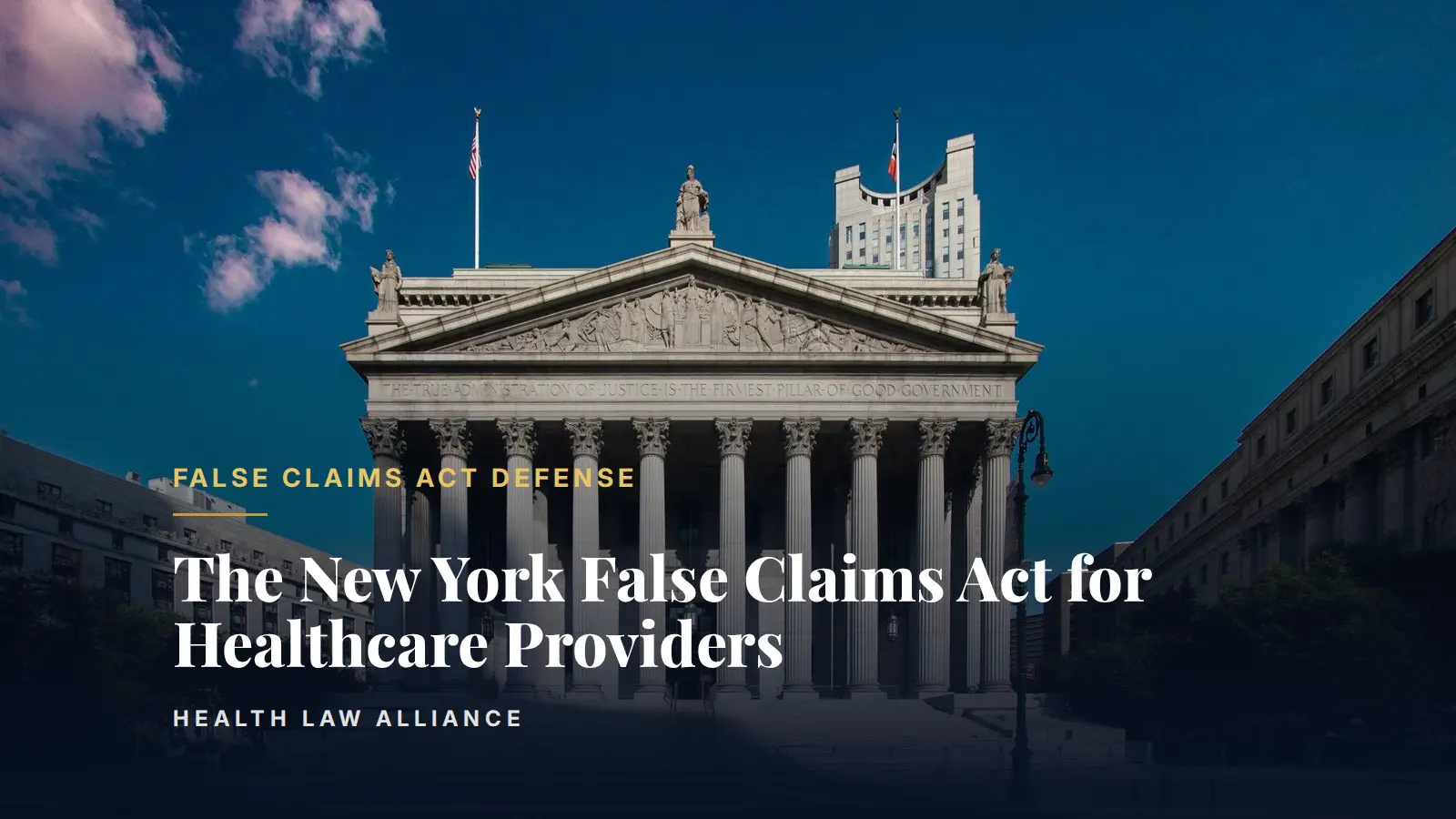
New York's False Claims Act gives the Attorney General's Medicaid Fraud Control Unit, and any private citizen who qualifies as a relator, a civil remedy against a healthcare provider that knowingly submits a false Medicaid claim. Codified at State Finance Law Article 13, the statute attaches a civil penalty of $6,000 to $12,000 per violation, adjusted to match the federal False Claims Act's penalty range, plus treble damages. A pharmacy, physician practice, or home health agency billing New York Medicaid is exposed not only to a state audit but to a qui tam lawsuit that an employee, biller, or competitor can file without the state's involvement.
What the New York False Claims Act Covers
The statute reaches any person who knowingly presents a false or fraudulent claim for payment, knowingly uses a false record material to a claim, or knowingly conceals an obligation to repay money owed to the state or a local government. State Finance Law Section 188 defines knowing to include actual knowledge, deliberate ignorance, or reckless disregard of the truth, and it expressly excludes acts that occur by mistake or as a result of mere negligence. A billing error made in good faith is not, by itself, a violation. One recurring theory in Medicaid cases treats billing for medically unnecessary services as the false claim itself.
Qui Tam Actions and Relator Rules
Any person may bring a qui tam civil action under the statute on behalf of themselves and the people of the state of New York, without waiting for the Attorney General to act. The relator's complaint is filed under seal in New York Supreme Court for at least 60 days, and the relator must separately serve the state with the complaint and a written disclosure of substantially all material evidence before that seal period runs. Within that window, the Attorney General decides whether to intervene and prosecute the action, convert it into a direct enforcement action, or decline to proceed.
If the state intervenes, the relator who initiated the case is entitled to between 15 and 25 percent of whatever the state or a local government recovers. If the state declines and the relator proceeds alone, that share rises to between 25 and 30 percent. An employee who is demoted or otherwise retaliated against for investigating or reporting a false claim can recover reinstatement and two times back pay under Section 191.
A healthcare provider can be sued under the New York False Claims Act by its own employee, held under seal for months while the Attorney General investigates, and never learn a case exists until the court lifts the seal.
How the Statute Reaches Medicaid Providers
The Attorney General must consult the Office of the Medicaid Inspector General before filing, superseding, or intervening in any Medicaid-related action, which puts the state's fraud-control apparatus inside every provider case from the outset. The Attorney General also reports the Medicaid Fraud Control Unit's recoveries under the Act to the Legislature each April 15. Because Medicaid is funded jointly by the state and federal government, the same billing conduct can trigger a parallel action under the federal False Claims Act at the same time as a New York action, and our analysis of state false claims acts and parallel recoveries covers how the two interact.
Penalties and the Statute of Limitations
A violation carries a civil penalty of $6,000 to $12,000, adjusted to match the federal False Claims Act's inflation-adjusted penalty, plus three times the state or local government's damages. A court may reduce that multiplier to double damages if the violator self-reports within 30 days of first learning of the violation, cooperates fully with the investigation, and had no actual knowledge that an investigation was already underway. A civil action must be commenced within 10 years of the violation, and the party bringing the case must prove every element, including damages, by a preponderance of the evidence.
Health Law Alliance's attorneys have overseen 2,000+ audits and handled 5,000+ matters, with 25+ years of experience.
Why Early Legal Counsel Is Critical
It is critical that healthcare providers promptly retain experienced healthcare defense counsel upon receiving a qui tam complaint, a Medicaid Fraud Control Unit subpoena, or any other government inquiry tied to Medicaid billing. Early legal intervention can protect the provider's rights, ensure appropriate responses to government requests, avoid inadvertent admissions, preserve relevant defenses, and allow counsel to communicate with investigators on the provider's behalf. Delaying legal representation can significantly affect the outcome of a matter and expose the provider to unnecessary risk.
How Health Law Alliance Can Help
Health Law Alliance defends healthcare providers named in New York False Claims Act matters, from a qui tam complaint under seal through any eventual Attorney General intervention. Our attorneys bring former prosecutors to the defense side of these cases. If your practice is facing a New York Medicaid false claims matter, our false claims act defense team is available for a free, confidential consultation.