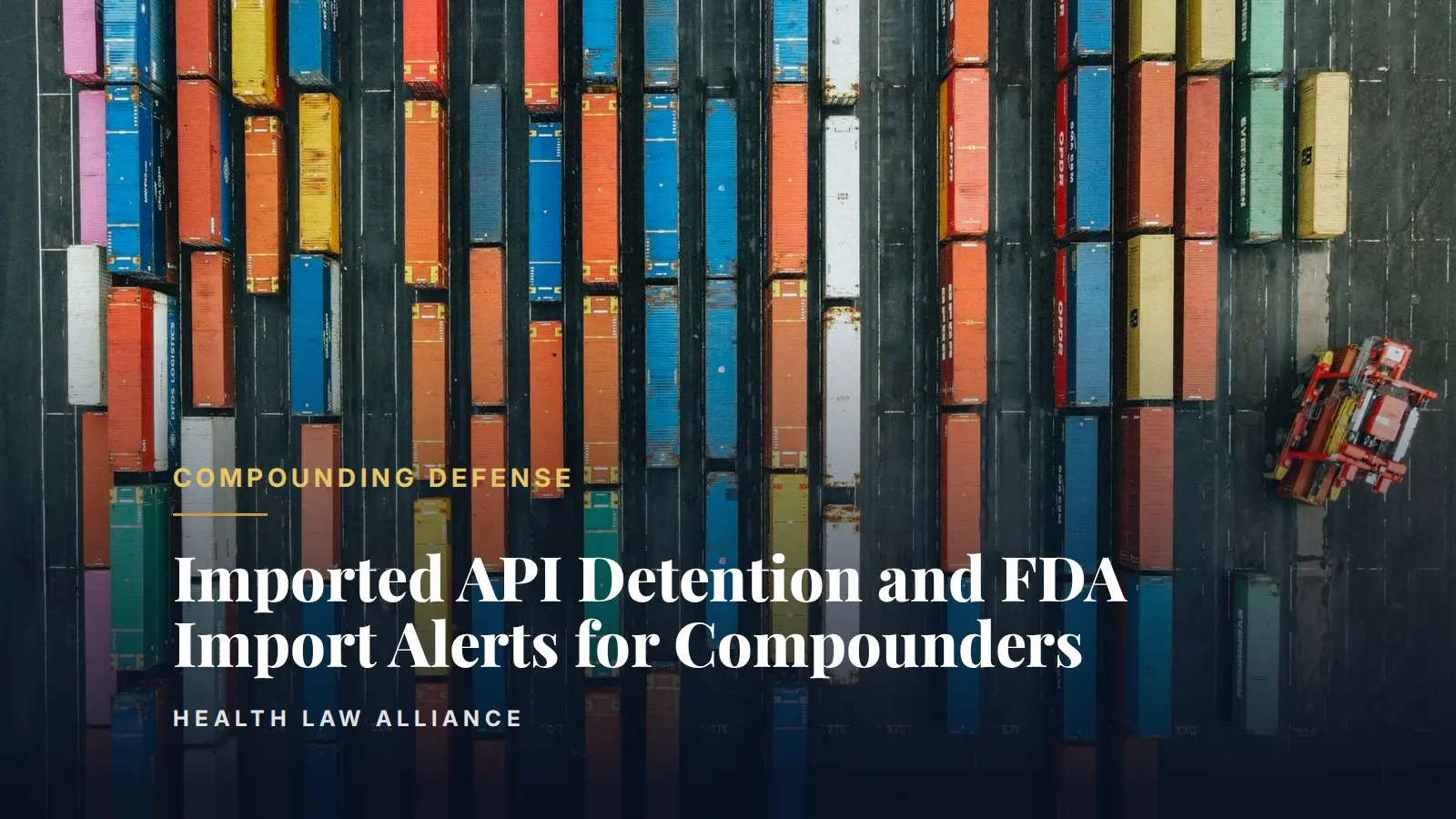
The Food and Drug Administration can detain an imported active pharmaceutical ingredient (API) before a compounding pharmacy ever sees it, based on an import alert rather than a test of that specific shipment. Under the agency's detention without physical examination (DWPE) authority, FDA flags a foreign manufacturer, a drug substance, or an entire product category for automatic detention once the agency has evidence of a pattern of violations. For a 503A/503B compounder that sources API from overseas, a single import alert can cut off a supplier overnight, strand paid-for inventory at the border, and leave the pharmacy defending its own sourcing practices in FDA's next inspection.
How FDA Detains Imported API
FDA's import alert system is a standing instruction to the agency's own field staff, not a one-time enforcement action. Each alert carries a Red List, a Yellow List, or a Green List. Firms and products on a Red List face automatic detention at the border. A Green List works the opposite way: it names manufacturers and products FDA has reviewed and will not detain, while every manufacturer left off the list stays subject to detention by default. FDA does not physically examine or test the shipment before detaining it. The agency describes the authority as letting field staff detain products without testing or otherwise physically examining them, based on evidence already tied to that manufacturer, shipper, or country.
The GLP-1 API Import Alert
FDA's current approach to foreign-sourced GLP-1 API illustrates how far this authority reaches. Import Alert 66-80, covering semaglutide, tirzepatide, and related GLP-1 receptor agonist bulk drug substances, instructs FDA divisions to detain shipments from any manufacturer not named on the alert's Green List. FDA states it evaluated 48 registered GLP-1 API manufacturing sites through onsite inspections and remote records requests, and found that 21 percent were noncompliant under section 501 of the FD&C Act, from evidence of noncompliance with current good manufacturing practice (cGMP) requirements or from a late response to FDA's records request. The agency also describes a recurring pattern: sites that register as API manufacturers, offer product for import, refuse to respond to FDA's records requests, and then deregister within a short period.
FDA evaluated 48 registered GLP-1 API manufacturing sites and found that 21 percent were noncompliant under section 501 of the FD&C Act, from cGMP noncompliance or an unanswered records request.
What an Import Alert Means for a Compounder
A compounding pharmacy does not need to be named in an import alert to feel its effect. Once a supplier's API sits on a Red List, or is absent from a Green List, FDA refuses entry to that shipment without examining it. The importer of record receives a notice of detention and an opportunity to present testimony on admissibility, including a private laboratory analysis, under 21 CFR 1.94. FDA has stated that the 503A exemption from cGMP leaves this risk in place: an exempt compounder's own facility sits outside cGMP, but the bulk API it buys remains a drug subject to cGMP under section 501(a)(2)(B) of the Federal Food, Drug, and Cosmetic Act. A detained or excluded API cannot be swapped for a domestic lot at the loading dock; the pharmacy is left explaining why it used that supplier.
Documenting the Supply Chain
FDA's Green List criteria describe what a compliant API manufacturer looks like, and the same records are what a compounder should already be collecting. The criteria include a certificate of analysis (COA) for recent lots, stability testing results, process validation records, and master batch records. A compounder's own file should mirror that list for every foreign API lot it receives, tracking the chain from manufacturer to supplier to pharmacy shelf. HLA's guide to API Sourcing Documentation: Certificates of Analysis walks through what a COA needs to contain and how it supports a product's beyond-use date. The same documentation gap drives the scrutiny described in Compounded GLP-1 Sourcing: Active Ingredient Suppliers Under Scrutiny; the same USP 797/800 compliance expectations extend to any imported API, not only GLP-1s.
Why Early Legal Counsel Is Critical
It is critical that compounding pharmacies promptly retain experienced healthcare defense counsel upon receiving a detention notice, an import alert inquiry, an FDA Form 483, or any other government inquiry tied to imported API. Early legal intervention can protect the pharmacy's rights, ensure an appropriate response to FDA's records requests, avoid inadvertent admissions, preserve relevant defenses, and allow counsel to communicate with the agency on the pharmacy's behalf. Delaying legal representation can significantly affect the outcome of a matter and expose the pharmacy to unnecessary risk.
How Health Law Alliance Can Help
Health Law Alliance represents compounding pharmacies and 503B outsourcing facilities in FDA import alert matters, detention responses, and the inspections that often follow a supply chain question. Health Law Alliance's attorneys have overseen 2,000+ audits and handled 5,000+ matters, with 25+ years of experience. If a shipment has been detained or a supplier has appeared on an import alert, contact our FDA regulatory compliance attorneys for a free, confidential consultation.