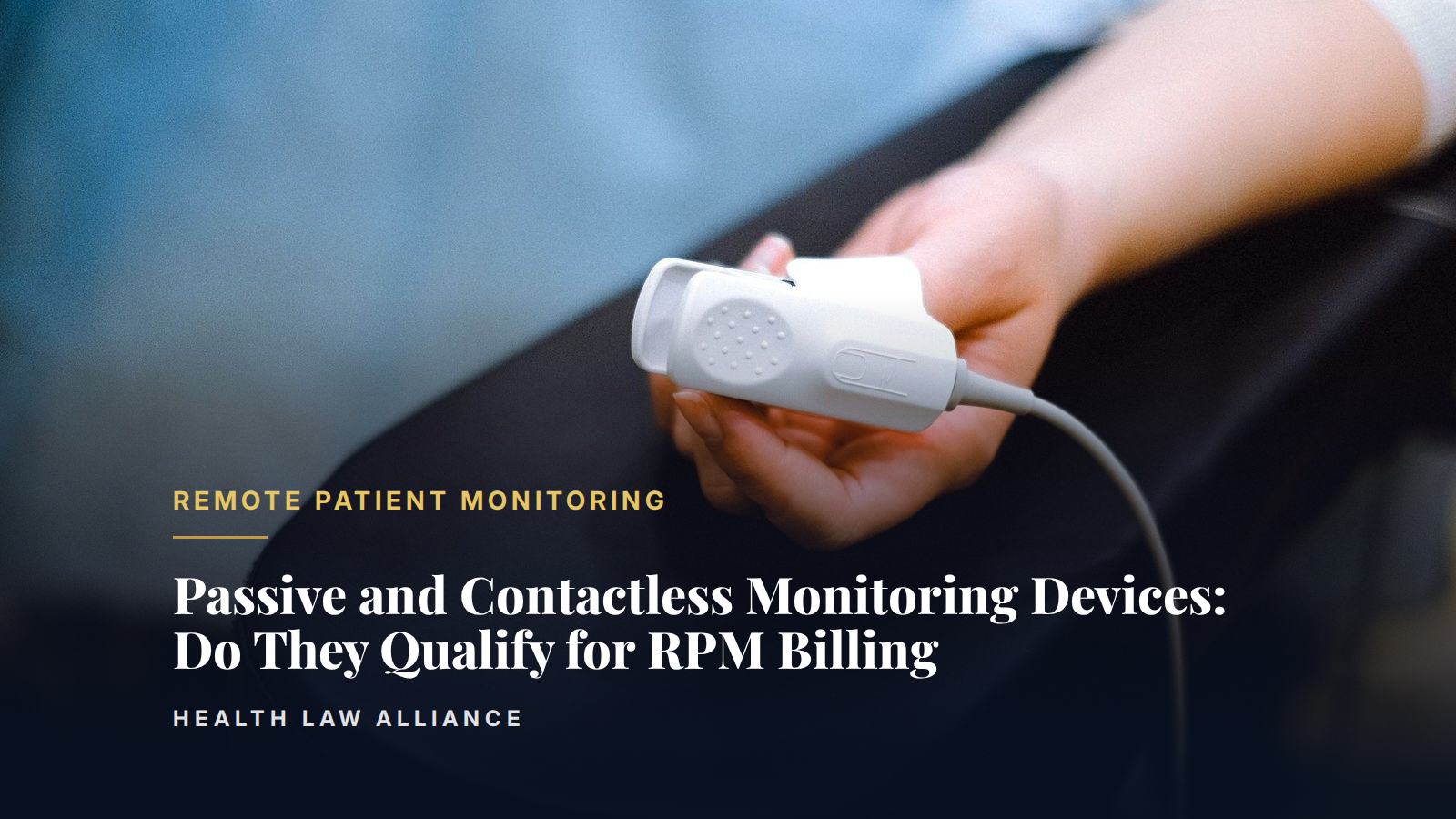
Nursing facilities and physician practices are billing CPT 99454 on bed sensors, radar-based sensors, and wearables that collect vital signs without any action from the patient, and regulators are watching the trend. The Department of Health and Human Services Office of Inspector General found in September 2024 that 43 percent of Medicare enrollees receiving remote patient monitoring did not receive all three billed components. For a facility billing the device-supply code on equipment the resident never touches, the live question is whether the device and its data pipeline meet CMS's standard for the code.
What CMS Requires for the Device Supply Code
A Unified Program Integrity Contractor (UPIC) auditing a facility's passive-monitoring claims checks two conditions CMS attached to CPT 99454 in its CY2021 Physician Fee Schedule final rule. First, the device must meet the medical device definition at Section 201(h) of the Federal Food, Drug, and Cosmetic Act, codified at 21 U.S.C. Section 321(h). Second, the data must be collected and transmitted electronically, meaning automatically, rather than self-reported. CMS's own language is direct: the device must be reliable and valid, and the data must reach the billing practitioner without patient self-report, on at least 16 of the 30 days in the billing period. Commercial payers do not all apply CMS's modifier and place-of-service rules, a variation covered in Telehealth Modifier Use and Payer Variation.
Passive and Contactless Devices Meet the Automatic Transmission Standard
Nothing in CMS's automatic-transmission requirement turns on whether the device touches the patient. A bed sensor under a mattress, a radar-based sensor on a wall, and a wearable on a wrist all transmit the same way, without the patient doing anything once the device is in place. A passive device closes the compliance gap that undercuts many wearable claims: no resident has to put it on, charge it, or keep it in range. The record still has to show which device collected the data, on which dates, for which resident, and that resident's site of service has to match the claim, the coding problem covered in Telehealth Place of Service Coding Errors. A documentation gap becomes a recoupment demand on every date billed that way, and a pattern of claims billed without a reliable log can also raise False Claims Act exposure, because each claim certifies the automatic-transmission requirement was actually met.
The FDA Authorization Question Facilities Cannot Skip
Meeting the automatic-transmission rule does not answer whether the device has the FDA marketing authorization a vital-sign monitor needs to be lawfully marketed. In a September 16, 2025 safety communication, the FDA addressed infant monitors worn by the infant or contactless, such as a sensor under a mattress or a wall-mounted camera, and stated that these devices require FDA marketing authorization to be lawfully marketed, because they measure specific vital signs rather than serving a general wellness purpose. A sensor marketed for sleep tracking does not become billable merely by producing a heart rate number. A device that monitors heart rate, respiratory rate, or oxygen saturation for medical management, the use a facility relies on to bill 99454, sits on the regulated side of that line, and the claim file should show which FDA pathway the device cleared.
Vendor Placement Arrangements and the Anti-Kickback Statute
Passive monitoring equipment in nursing facilities can arrive through a vendor placement arrangement instead of a direct purchase. A vendor places bed sensors or radar units across a facility, sometimes at no charge, in exchange for the facility's referrals, device orders, or billing volume. That arrangement can implicate the Anti-Kickback Statute at 42 U.S.C. Section 1320a-7b(b), which reaches remuneration offered to induce referrals of federally payable items or services. Some arrangements run through a monitoring platform's own contract with the facility, whose fee structure draws separate scrutiny, covered in Telehealth Platform Contracts: Fee Structures Under Scrutiny. A facility that cannot show the placement was priced at fair market value carries a second exposure layered on the claim's documentation problem.
CMS's automatic-transmission rule turns on the transmission log. A facility that cannot produce that log for a contactless device, however reliably the sensor performs, is defending a recoupment demand.
Why Early Legal Counsel Is Critical
It is critical that healthcare providers promptly retain experienced healthcare defense counsel upon receiving a subpoena, audit notice, investigative request, or other government inquiry. Early legal intervention can protect the provider's rights, ensure appropriate responses to government requests, avoid inadvertent admissions, preserve relevant defenses, and allow counsel to communicate with investigators on the provider's behalf. Delaying legal representation can significantly affect the outcome of a matter and expose the provider to unnecessary risk.
How Health Law Alliance Can Help
Health Law Alliance's attorneys have overseen 2,000+ audits and handled 5,000+ matters, with 25+ years of experience. If your facility or practice is billing CPT 99454 on bed sensors, radar-based sensors, or wearables and has received an audit request, an additional documentation request, or a UPIC inquiry, contact Health Law Alliance's remote patient monitoring audit defense attorneys for a free, confidential consultation.