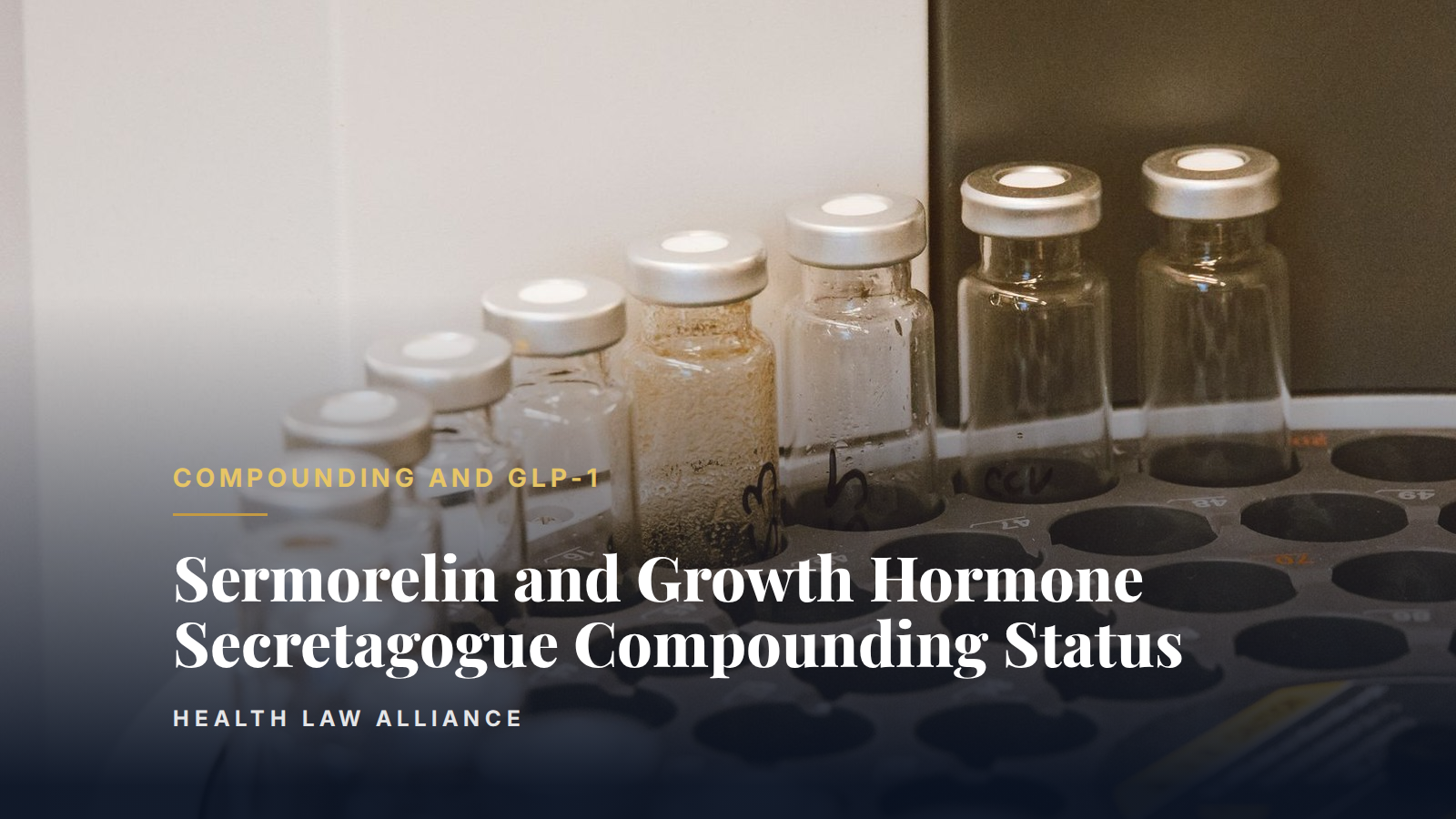
FDA's Category 2 list of bulk drug substances now reaches a growing set of growth hormone secretagogues, but sermorelin is not on it, and the gap carries real consequences. Category 2 placement means FDA would consider enforcement action against a pharmacy that compounds the substance, while sermorelin's eligibility rests on a narrower, substance-specific legal history tied to a drug FDA approved decades ago that its maker later discontinued. A clinic that treats every growth hormone peptide its compounding pharmacy offers as legally interchangeable is exposed the moment that assumption turns out to be wrong.
Sermorelin's Compounding Status
Sermorelin acetate has an unusual history among compounded peptides because it was once an approved drug. FDA approved GEREF (sermorelin acetate) injection, 0.05 mg base/amp, on December 28, 1990, for a diagnostic indication, and GEREF (sermorelin acetate) injection, 0.5 mg and 1.0 mg base/vial, on September 26, 1997, for pediatric growth hormone deficiency. EMD Serono discontinued both products in 2008, and FDA withdrew the underlying approvals effective June 18, 2009.
A withdrawal alone does not settle a bulk substance's compounding eligibility. In a March 4, 2013 Federal Register notice responding to a citizen petition, FDA determined that both GEREF products were not withdrawn for reasons of safety or effectiveness, a finding the agency reached after reviewing its own files and the available postmarketing literature. That finding is why GEREF sits on the Orange Book's Discontinued Drug Product List rather than a list of safety-based withdrawals, and it is the legal basis compounders point to when sourcing sermorelin as a component of a previously approved drug.
What FDA's Category 2 List Covers
Category 2 names bulk drug substances FDA has reviewed and determined present significant safety risks for compounding. As of FDA's April 22, 2026 update, the list includes several growth hormone secretagogues, among them GHRP-2. Health Law Alliance's breakdown of which substances are on FDA's Category 2 list covers the full current list and the safety finding FDA cited for each entry.
Sermorelin does not appear on that list. The absence reflects a specific legal pathway rather than a safety clearance. Its eligibility runs through the approved-drug-component history described above, not FDA's bulks-list review process, and FDA can revisit either determination as new safety information comes in.
Why the Distinction Matters for Clinics
A clinic's exposure turns on its compounding pharmacy's sourcing, not the clinic's own prescribing pad. A product compounded from a Category 2-listed secretagogue falls outside the enforcement-discretion framework that lets 503A and 503B pharmacies operate without going through full new-drug approval. A clinic that prescribes a compounded product without confirming which bulk substance its pharmacy actually used inherits that exposure, both in its own marketing claims and in how it documents medical necessity.
Eligibility to compound an ingredient and approval for the specific use a patient is prescribed it for are two different legal questions. GEREF's own approvals covered pediatric growth hormone deficiency and a diagnostic indication, not the broader uses sermorelin is compounded for today, and a clinic's marketing should reflect that gap rather than imply approval the record does not support.
A compounded growth hormone secretagogue injectable is also subject to the same operational rules that apply to any sterile compound, regardless of which category its bulk substance falls in. USP 797/800 sterile compounding standards, a documented beyond-use date, and, for 503B outsourcing facilities, cGMP manufacturing all still apply. A pharmacy's bulk substance sourcing can be fully lawful and the finished product can still fail on facility compliance, and a clinic relying on that pharmacy inherits both risks.
A bulk substance's absence from FDA's Category 2 list is a narrow legal finding, not a safety endorsement or a license to market any use a clinic chooses.
Why Early Legal Counsel Is Critical
It is critical that compounding pharmacies and the clinics they supply promptly retain experienced healthcare defense counsel before an FDA inspection, a warning letter, or a state board inquiry turns a sourcing question into an enforcement matter. Early legal intervention can review a pharmacy's bulk substance sourcing against FDA's current categories, correct marketing claims that conflate compounding eligibility with FDA approval, and help a clinic document its prescribing rationale before a regulator asks for it. Delaying legal representation can significantly affect the outcome of a matter and expose the practice to unnecessary risk.
How Health Law Alliance Can Help
Health Law Alliance represents compounding pharmacies, clinics, and physician practices on peptide sourcing, labeling, and FDA inspection defense. If a pharmacy or clinic needs its sermorelin or growth hormone secretagogue sourcing reviewed, contact Health Law Alliance's peptide compounding attorneys for a free, confidential consultation.