Texas State Board of Pharmacy inspectors enforce compounding authority by license class. The board's own rules set the baseline: a Class A pharmacy (Community Pharmacy) and a Class C pharmacy (Institutional Pharmacy) hold the general authority to compound non-sterile preparations under 22 TAC 291.131, while sterile compounding sits under separate classes entirely. A pharmacy that compounds a sterile preparation without the matching sterile designation, or that cannot produce its compounding records on inspection, turns a routine inspection into a board complaint and, from there, a Texas pharmacy audit defense matter.
Class A and Class C: The Non-Sterile Baseline
Class A is the community pharmacy license and Class C is the institutional pharmacy license, the two license types set out in 22 TAC Subchapter B (291.33) and Subchapter D (291.74). Section 291.131 extends non-sterile compounding authority to Class A, Class C, and Class E (non-resident) pharmacies compounding for an identified patient under a prescription or medication order. Every batch requires a master formulation record naming the formula, the components, the compounding directions, and the testing requirements, plus a compounding record documenting the identity, amount, and lot number of each component and the compounding pharmacist's signature. Both records stay with the pharmacy for at least two years and must be produced within 72 hours of a request from a board inspector. That state license structure sits alongside the federal 503A/503B framework, under which a 503B outsourcing facility follows cGMP regardless of the facility's Texas board class.
Sterile Compounding Requires a Separate Class
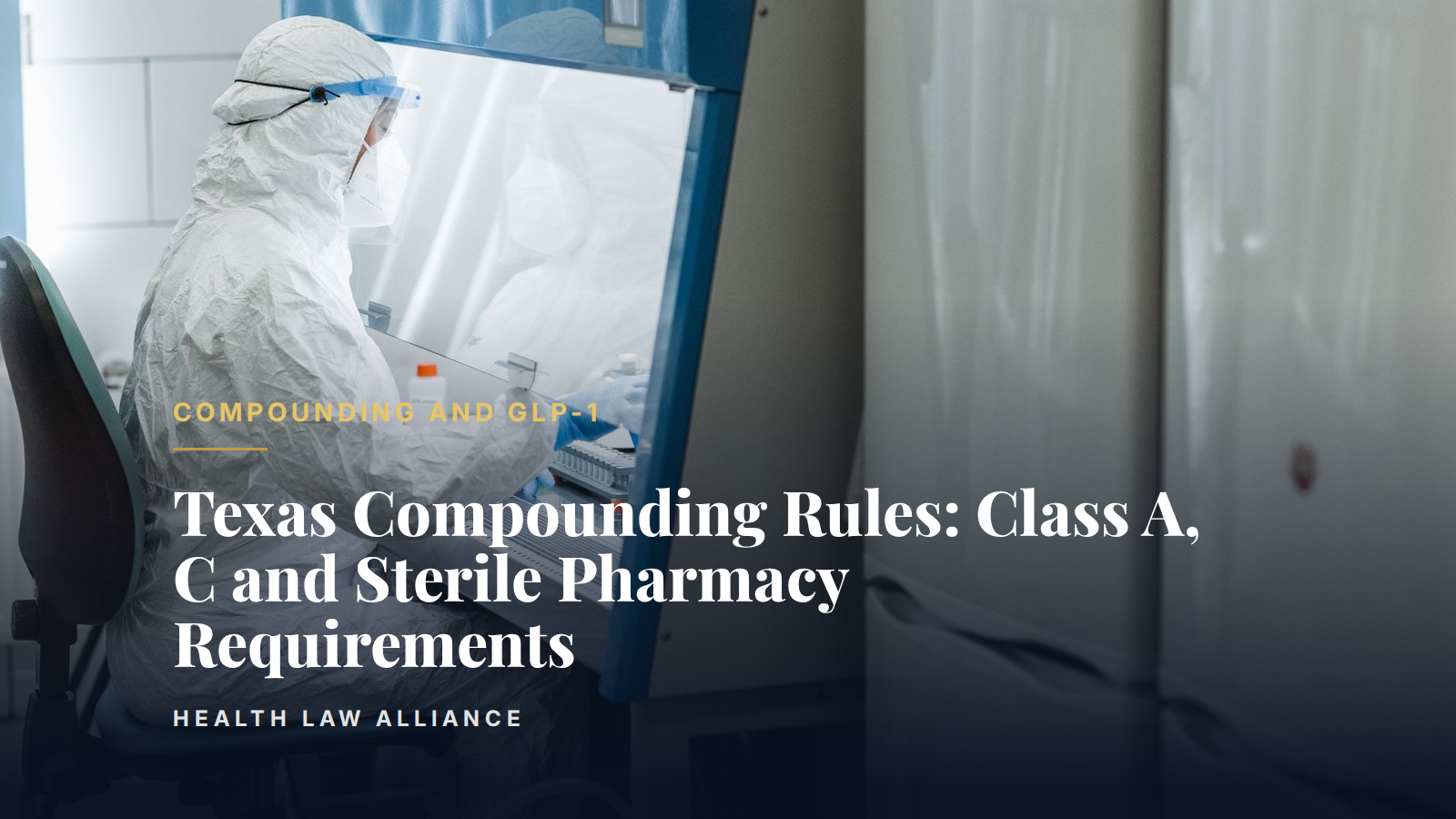
Sterile compounding requires a license beyond Class A or Class C alone. Texas created Class A-S and Class C-S for pharmacies that compound sterile preparations, alongside Class B (nuclear pharmacy) and Class E-S, and 22 TAC 291.133 governs all four. Section 291.133 builds its standards on USP 797/800, requiring a primary engineering control device, such as a laminar airflow hood, biological safety cabinet, or compounding aseptic isolator, that maintains ISO Class 5 air quality inside a buffer area rated ISO Class 7 (ISO Class 8 for a Class B pharmacy). Every sterile preparation then carries a beyond-use date assigned under that same framework, with a pharmacy's sterility and endotoxin testing program layered on top of it.
A Class A community pharmacy license covers only non-sterile compounding. Texas requires the separate Class A-S designation under 22 TAC 291.133 before a pharmacy may prepare a single sterile compound.
What Personnel Must Prove Before They Compound
Section 291.133 ties the sterile designation to the people compounding, not just the room. A pharmacist needs a minimum of 20 hours of didactic instruction through a single course, plus facility-specific training, before compounding sterile preparations; a pharmacy technician needs 40 hours. Every compounding staff member must then pass written and media-fill testing of aseptic technique, repeated every 12 months for low- and medium-risk compounding and every 6 months for high-risk compounding, and must produce a gloved fingertip and thumb sample that grows zero colony-forming units before the pharmacy can authorize that person to compound. Texas tracks those training and competency records separately from the compounding log, and the board can request them on their own.
What Board Inspectors Actually Check
A Texas inspector checks the license class against what the pharmacy is doing: the master formulation and compounding records under 291.131, available inside the 72-hour window; the training and competency-testing files for every person compounding sterile preparations under 291.133; and the primary engineering control device and buffer area classification against the ISO rating tied to that pharmacy's class. A pharmacy compounding controlled substances carries DEA registration obligations on top of the board's class rules, a separate inspection track entirely. A Class A pharmacy compounding sterile preparations without the A-S designation is operating outside its license class under 291.133.
Why Early Legal Counsel Is Critical
It is critical that Texas compounding pharmacies promptly retain experienced healthcare defense counsel upon receiving a board inspection finding, a notice of violation, or any other Texas State Board of Pharmacy inquiry. Early legal intervention can protect the pharmacy's rights, ensure appropriate responses to board requests, avoid inadvertent admissions, preserve relevant defenses, and allow counsel to communicate with board investigators on the pharmacy's behalf. Delaying legal representation can significantly affect the outcome of a matter and expose the pharmacy to unnecessary licensure risk.
How Health Law Alliance Can Help
Health Law Alliance defends compounding pharmacies in Texas State Board of Pharmacy inspections and license actions, including disputes over class designation, sterile compounding findings, and recordkeeping citations. Health Law Alliance's attorneys have overseen 2,000+ audits and handled 5,000+ matters, with 25+ years of experience. If your pharmacy has received a board inspection finding or notice tied to its Class A, Class C, or sterile compounding license, contact us for a free, confidential consultation before you respond.