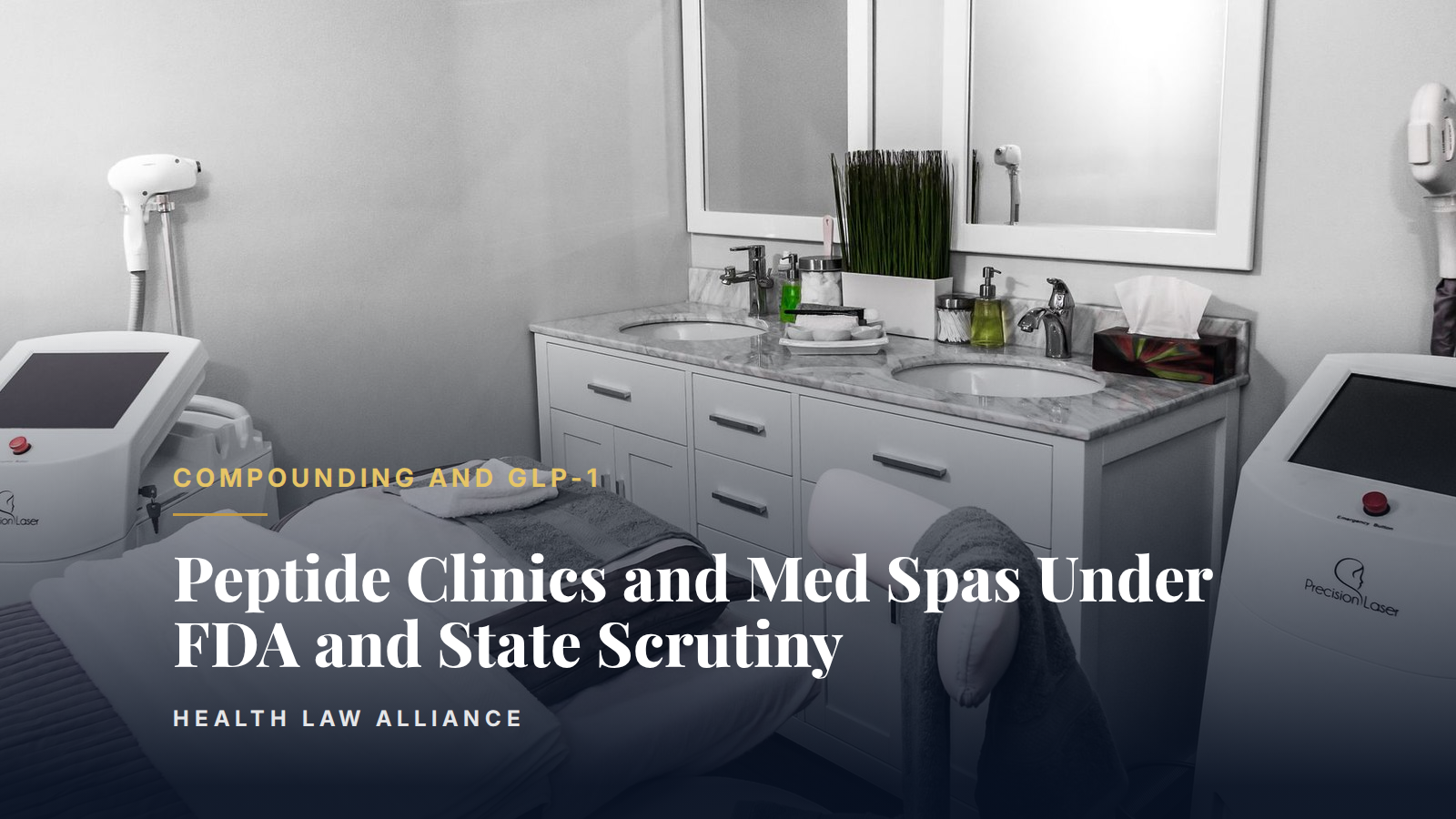
Medical spas and wellness clinics have added peptide therapies such as BPC-157, growth-hormone-releasing peptides, and semaglutide to their menus. Most of these products are not FDA-approved drugs, and many come from online sellers labeled for research use only, not for human use. A clinic that prescribes or administers one carries exposure on two levels: an FDA level over the product itself, since giving an unapproved substance to a patient makes it an unapproved new drug under the Federal Food, Drug, and Cosmetic Act, and a state level over the clinic's practice of medicine or pharmacy, since a physician who delegates prescribing to non-physician staff without real oversight can draw a state board inquiry on its own.
Why Many Clinic Peptide Programs Fall Outside FDA Approval
Few of the peptides on a typical med spa menu carry FDA approval for any indication. BPC-157, a synthetic peptide marketed for tissue repair and recovery, has no FDA-approved use and is not currently on the list of substances eligible for compounding under Section 503A. FDA's own bulk drug substances page lists BPC-157 among the nominations withdrawn by their nominators, not among the substances cleared for compounding, and a July 2026 FDA advisory committee vote recommending the peptide for the 503A list is advisory only, pending HHS Secretary approval and formal rulemaking. A clinic administering BPC-157, whether from a compounding pharmacy or a direct online seller, is administering a product FDA has not cleared for that use.
Bulk Drug Substance Status Under 503A and 503B
The 503A/503B framework splits pharmacy compounding into two pathways: 503A pharmacies compound against a specific patient prescription, while 503B outsourcing facilities compound in bulk for office use under cGMP standards. FDA sorts bulk substances nominated for either pathway into categories, and Category 2 covers substances FDA has found to raise significant safety risks. On FDA's current list, ibutamoren mesylate carries a Category 2 flag for both pathways over the risk of congestive heart failure, and growth-hormone-releasing peptide-2, peptide-6, and ipamorelin acetate carry the same flag for 503B compounding over immunogenicity and impurity concerns. A clinic relying on a compounding pharmacy for any of these peptides is relying on a substance FDA has already flagged as a safety risk.
Sourcing Outside a Licensed Pharmacy Compounds the Exposure
Several clinics source peptides directly from online storefronts rather than a licensed 503A or 503B pharmacy, and FDA pursues those storefronts directly. In June 2026, FDA warned a Florida seller, Wholesale Peptide, that two of its products, including the peptide gonadorelin, were unapproved new drugs intended to treat or prevent disease, based on the seller's own marketing claims. The letter named no clinic, but the same reasoning reaches whoever administers the product: a substance given to a patient for a therapeutic purpose is a drug under the Federal Food, Drug, and Cosmetic Act regardless of the seller's label, and sourcing from a storefront FDA has already warned adds to the clinic's exposure rather than removing it. Clinics sourcing from a 503A pharmacy instead still carry exposure if the pharmacy compounds in anticipation of prescriptions rather than against one on hand, a practice capped under federal law and addressed in Anticipatory Compounding Limits. The same sterile-handling rules, addressed in Ampules, Single-Dose Vials and Multiple-Dose Containers Under USP 797, determine whether a vial administered across several patients stayed within its beyond-use date under USP 797/800.
State Board Oversight of Medical Spa Prescribing
A med spa's medical director is often the only licensed prescriber on site, and peptide and semaglutide protocols may be written and administered by nurse practitioners, physician assistants, or aestheticians under that one physician's standing orders. State medical boards and boards of pharmacy can open an inquiry into that delegation: whether the physician examined the patient, whether supervision amounted to more than a signature on a protocol, and whether non-prescribers administered a substance the physician never personally evaluated. A finding of inadequate supervision reaches the physician's license directly, independent of any FDA action on the product itself.
FDA's own bulk drug substances list places BPC-157 among the nominations withdrawn by their nominators, not among the substances cleared for pharmacy compounding, so a clinic offering it is offering a product FDA has not approved for any use.
Health Law Alliance's attorneys have overseen 2,000+ audits and handled 5,000+ matters, with 25+ years of experience.
Why Early Legal Counsel Is Critical
It is critical that medical spas, wellness clinics, and their supervising physicians promptly retain experienced healthcare defense counsel upon receiving an FDA inspection, warning letter, or state board inquiry into a peptide program. Early legal intervention can protect the clinic's rights, address a sourcing or supervision gap a regulator has flagged, and allow counsel to communicate with FDA or the board on the clinic's behalf. Delaying legal representation can significantly affect the outcome of an inspection or licensing matter and expose both the clinic and its prescribers to unnecessary risk.
How Health Law Alliance Can Help
Health Law Alliance represents medical spas, wellness clinics, and their physicians on FDA sourcing and compounding exposure and state board inquiries, as part of our broader compounding pharmacy defense practice. If your clinic has received an FDA inspection, warning letter, or state board inquiry tied to a peptide or GLP-1 program, contact us today for a free, confidential consultation with our peptide compounding attorneys.